
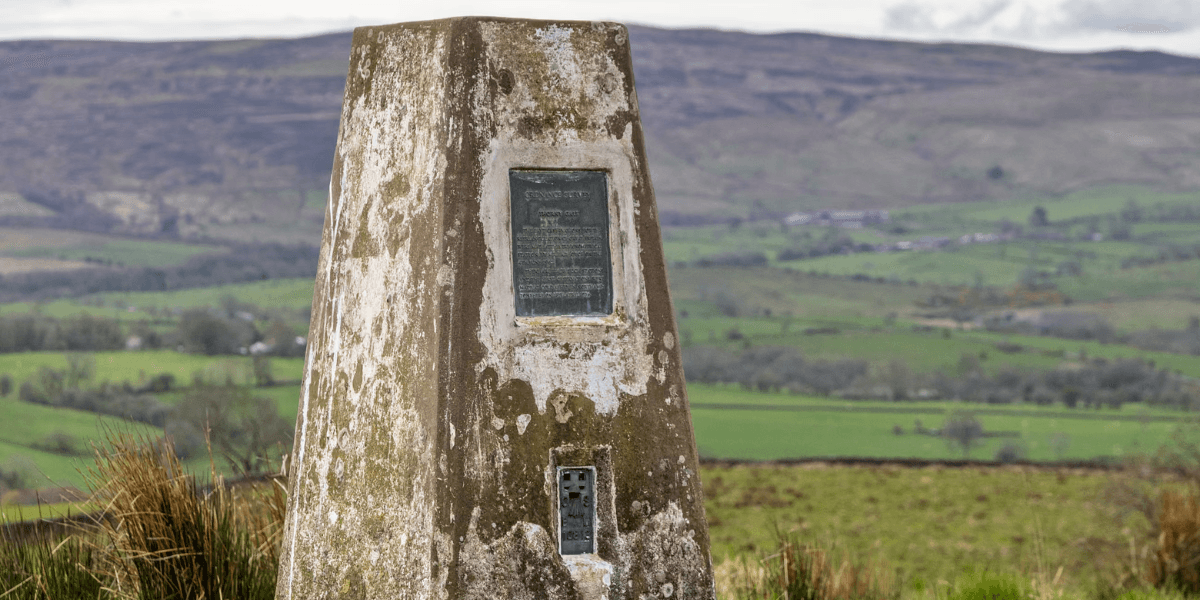
Campaigners have launched a bid to secure heritage protection for two concrete pillars that played pivotal roles in mapping Britain’s landscape.
The Twentieth Century Society has submitted applications to Historic England, seeking listed status for what it considers the “most historically significant trig points in the country”.
The campaign coincides with a notable milestone, as this week marks exactly 90 years since the very first pillar was erected in Cold Ashby, Northamptonshire, on April 18, 1936.
Approximately 6,500 of these stone and concrete markers remain scattered across Britain’s peaks, hills and high points, although satellite navigation technology rendered them redundant during the 1990s.
These distinctive 4ft pillars were conceived in 1935 by Brigadier Martin Hotine, a Royal Engineers officer who had served during the First World War.
Brig Hotine spearheaded the retriangulation project for the Ordnance Survey, developing a standardised design that would transform British cartography.
Prior to this initiative, mapmaking across the country depended on principal triangulation, an unwieldy and inconsistent system for calculating the angles between landmarks and geographical features.
The pillars enabled surveyors to take precise measurements that would reconstruct rural landscapes with unprecedented accuracy.
The very first pillar erected in Cold Ashby, Northamptonshire was made redundant during the 1990s
|
GETTY
Despite losing their practical function to GPS technology, the posts continue serving as waymarkers for walkers and ramblers navigating Britain’s countryside.
Oli Marshall, campaigns director for the society, said: “These pillars deserve their place in history they are the thing you strive for on a long walk, the landmark you pose for in a selfie in a blustery gale on top of a hill.
“They’re a bit of an institution, we want to give them recognition.”
Mr Marshall acknowledged the pillars face no immediate threat of vanishing entirely.
However, he noted “several hundred have been wiped out” either demolished by farmers and landowners or succumbing to weathering and natural decay.
The loss of these markers has prompted the society to seek formal protection before more disappear from the landscape.
The society has identified two pillars for protection: the Cold Ashby marker, constructed as the inaugural trig point, and one at Thorny Gale near Appleby-in-Westmoreland in Cumbria.
Final observations were recorded at the latter on June 4, 1962.
A 1992 adoption scheme aimed at safeguarding the pillars ultimately proved unsuccessful.
Both structures bear bronze plaques commemorating their significance in charting the British landscape.
Mr Marshall said: “It’s difficult to get anything listed as quite rightly, the criteria are strict.
“What we would love to do in future, if these two are successful, is start to see some of them sponsored and protected by community groups.”