
Residents of the Welsh seaside town of Barmouth are growing increasingly alarmed as the full extent of proposed flood defence works becomes clear.
A two-year coastal protection project along the north promenade is set to commence this summer, with Cyngor Gwynedd finalising designs for new defences, including a 1.2 kilometres secondary wall reaching heights of up to 1.7 metres.
Local construction worker Kye Smith, 38, has emerged as a vocal critic of the plans.
“Residents will feel like they are in a maximum security prison,” he said.
Mr Smith argues the towering concrete structure will block light and obstruct views for those living on nearby estates.
He has created visual representations using planks to demonstrate the wall’s impact.
From the promenade, which sits lower on a slope, Mr Smith calculates the effective height would appear even greater at 2.25 metres.
The proposed rock armour has also drawn sharp criticism from Smith, who believes it poses serious risks to beachgoers.
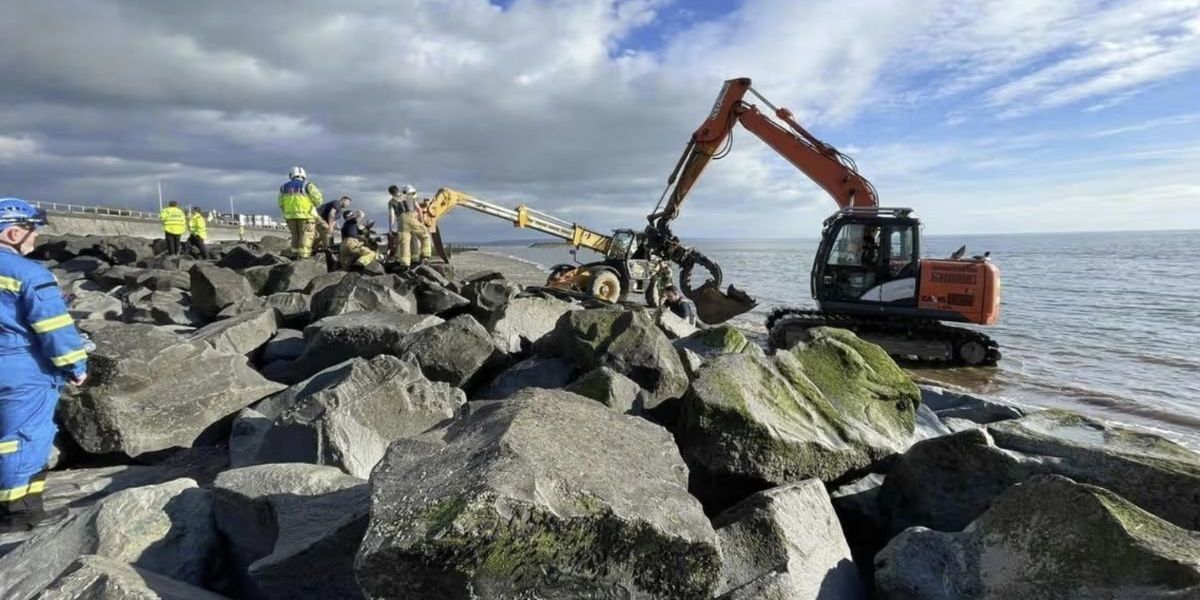
An incoming tide was perilously close to rock armour in Tywyn when a trapped girl was freed after a three-hour rescue operation
|
MID & NORTH WALES COASTGUARD
“You are essentially putting an obstacle course akin to a climbing frame on the beach,” he told North Wales Live.
Barmouth attracts large numbers of visitors from English cities, earning it the nickname “Little Birmingham”.
Mr Smith fears excited children will inevitably attempt to scramble over the boulders after arriving at the seafront.
He points to a troubling incident in April 2024 when a young girl became wedged in rock armour at nearby Tywyn beach.
Projected flood risk to Barmouth in the event of a one-in-200 year storm – including with the proposed defence (bottom)
|
CYNGOR GWYNEDD
Coastguards, firefighters, paramedics and an air ambulance were deployed, with heavy machinery required to free her after approximately three hours as the tide approached.
“People will do anything to get to the beach,” Mr Smith said.
“I can see similar issues happening in Barmouth.”
Mr Smith has put forward alternative solutions he believes would better serve the community.
He advocates for an offshore reef positioned at a depth of 15 to 20 metres, arguing it would function as a natural wave barrier while supporting marine life.
“By the time the waves reach the shore, their energy will have been dispersed, greatly reducing their impact on the beach and sea defences,” he explained.
The resident is also concerned about the loss of usable beach.
The rock revetment has reportedly been expanded to 18 metres in width, which Mr Smith estimates will consume roughly 21,600 square metres of soft sand.
He has established a Facebook group to highlight these issues, which has already attracted nearly 600 members in a town of 2,500 permanent residents.
The scheme aims to safeguard an estimated 757 properties from potentially devastating flooding, with current modelling showing parts of the resort could be submerged more than two metres deep during a one in 200-year storm event.
Critical infrastructure including the Cambrian railway line is also at risk. Council consultants YGC have stated that protecting properties, businesses and transport links remains their primary objective.
Under the plans, the promenade and Marine Parade will be permitted to flood during severe weather, effectively functioning as a temporary reservoir.
“Allowing the promenade to flood balances the need for flood protection with maintaining the character of the town,” YGC’s experts said.
Construction is scheduled to conclude by summer 2028, with work paused during school holidays to minimise disruption to tourism.