
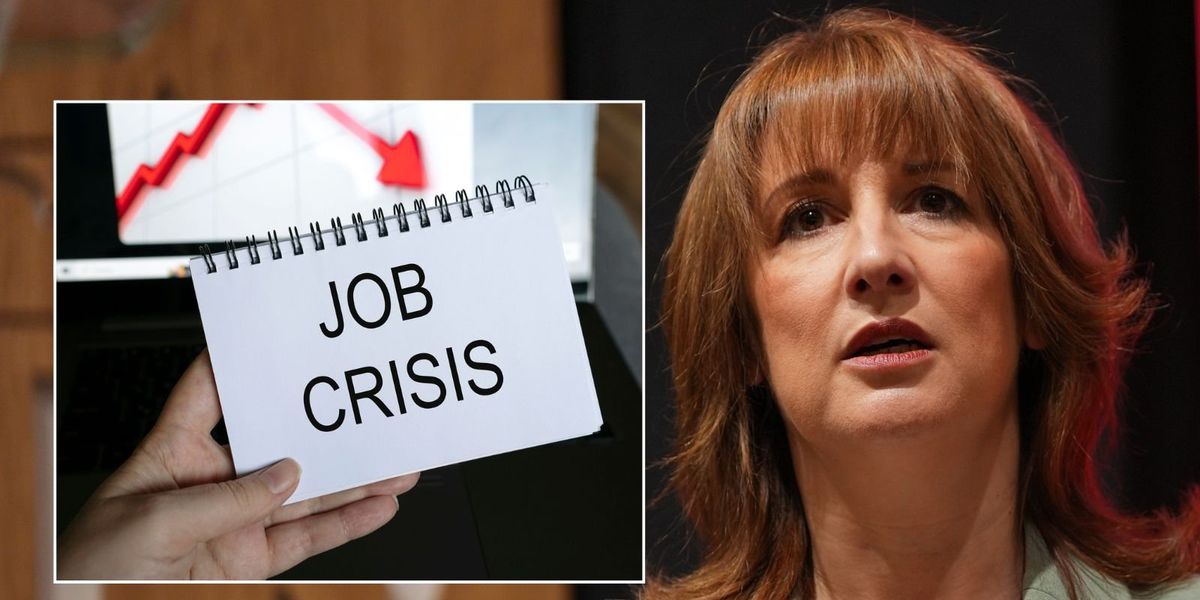
Rachel Reeves has come under renewed pressure as Britain’s long-term unemployment rate reaches a 10-year high.
Official data shows 474,000 people have been without work for more than a year, , marking the worst level in a decade, according to Office for National Statistics data released today.
The figure, which captures those without work for more than a year, represents the highest total since January 2016.
Since Labour entered government in July 2024, an additional 129,000 individuals have joined the ranks of the long-term jobless, underscoring the damage that Rachel Reeves’s tax increases have inflicted on the labour market.
Economists warn this prolonged spell of worklessness poses serious risks to economic growth, as it suppresses productivity, depletes tax receipts and constrains household spending.
Stephen Evans, chief executive of the Learning and Work Institute, said: “Nipping long-term unemployment in the bud really is massively important for the prospects of the economy, as well as for those individuals.”
The Chancellor’s £26billion National Insurance raid, unveiled in her inaugural Budget, triggered a sustained cooling in the jobs market that has only intensified since.
Successive minimum wage rises, combined with Labour’s Employment Rights Act reforms, have compounded the pressure on businesses by driving up employment costs.
Andrew Wishart, an economist at Berenberg, said: “By making companies more cautious about hiring, higher employer National Insurance, minimum wage and the strengthening of worker protections in the Employment Rights Act have probably raised the structural rate of unemployment.”
The number of unemployed people per job vacancy is at a new post-pandemic high | GB NEWS
Job vacancies have tumbled to their lowest point in five years as firms cut back on recruitment to offset the heavier tax burden.
The retail and hospitality sectors have shed more than 150,000 workers in the year to April 2026, according to ONS figures.
Young workers have borne the heaviest burden of the deteriorating employment landscape, with the jobless rate among 16 to 24-year-olds climbing to 16.2 per cent, the steepest since January 2015.
The Chancellor’s decisions to raise both the minimum wage and employer National Insurance contributions have prompted many companies to scale back their recruitment of younger staff.
The Chancellor’s decisions to raise both the minimum wage and employer National Insurance contributions have prompted many companies to scale back their recruitment of younger staff
|
GETTYFergus Jimenez-England, economist at the National Institute of Economic and Social Research, said: “There is a risk that labour market entrants become discouraged should they fail to find work quickly enough.”
The number of 18 to 24-year-olds trapped in long-term joblessness has more than doubled since 2016.
Institute for Fiscal Studies data shows nearly 640,000 young people aged 18 to 24 are now receiving out-of-work benefits, up from 556,000 at the close of 2022.
Helen Whateley, the shadow work and pensions secretary, said: “Job hunting for a few months is tough. And being long term unemployed is soul destroying.
The retail and hospitality industries, which depend heavily on younger employees, have suffered some of the sharpest workforce reductions
|
GETTY“Time out of work takes its toll not just on the unemployed and their families, but also on the taxpayer. Our welfare system should be a safety net, but for too many welfare has become a long-term alternative to work.”
The retail and hospitality industries, which depend heavily on younger employees, have suffered some of the sharpest workforce reductions.
Pat McFadden, the Work and Pensions Secretary, acknowledged that the Iran war “is casting a shadow on the labour market” but pointed to 416,000 more people in employment compared with a year ago.
He added that “boosting opportunity and tackling youth unemployment in every area remains our priority”.