
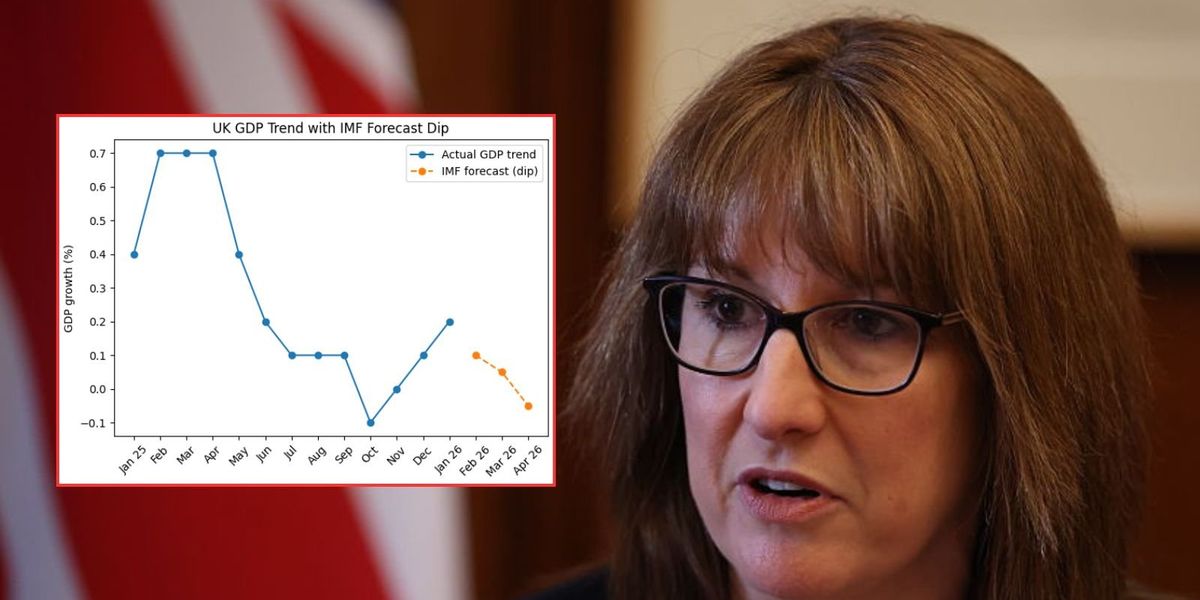
UK economic growth forecasts have been downgraded as the escalating Iran war threatens to derail the global economy, the International Monetary Fund (IMF) has warned.
The influential body said inflation is now expected to come in higher than previously forecast, adding to pressure on households and businesses.
In its latest outlook, the IMF cautioned that a global recession could be a “close call” in a worst-case scenario, with further disruption linked to the ongoing conflict.
The forecasts mark the IMF’s first assessment since tensions between US-Israeli and Iranian forces intensified at the end of February, sending shockwaves through global markets.
Growth forecasts for the UK have been sharply reduced, with the influential financial body now predicting gross domestic product will expand by just 0.8 per cent this year, down from the 1.3 per cent it anticipated in January.
The IMF released its updated economic outlook on Tuesday, marking the first set of projections since fighting between US-Israeli and Iranian forces erupted at the end of February.
Next year’s growth expectations have also been trimmed, falling from 1.5 per cent to 1.3 per cent.
Britain’s economy expanded by 1.4 per cent in 2025, according to recently revised figures from the Office for National Statistics.
Rising prices present another challenge for households, with inflation now expected to average 3.2 per cent during 2026, significantly above the 2.5 per cent previously forecast.
The IMF anticipates this will ease to 2.4 per cent the following year, though still missing the Bank of England’s twp per cent target. The jobs market faces mounting pressure too, with unemployment projected to climb to 5.6 per cent this year from 4.9 per cent in 2025.
Susannah Streeter, chief investment strategist at Wealth Club, said: “As companies batten down the hatches and try to wait for the storm to pass, investment plans are being trapped. The UK is stuck in a stagflation scenario and risks of a recession are rising fast.”
Experts warn The UK is stuck in a stagflation scenario and risks of a recession are rising fast
|
GETTY
Energy costs lie at the heart of these worsening forecasts. Oil and gas prices have surged since the conflict began, driven by attacks on production facilities and the blockade of the Strait of Hormuz disrupting supplies.
Petrol prices have jumped 19 per cent since fighting started, while diesel costs have risen by more than a third.
Experts point to pricier fuel and higher food costs as key drivers of persistent inflation.
The IMF cautioned that a worldwide recession remains a “close call” should the conflict escalate further. Such an outcome would mark only the fifth time since 1980 that global growth has fallen below twp per cent, with the previous two instances being the 2008 financial crisis and the Covid-19 pandemic.
IMF economic counsellor Pierre-Olivier Gourinchas wrote in a foreword to the report that the global outlook has “abruptly darkened”, knocking the world economy off its steady growth path.
Mr Gourinchas warned: “The closure of the Strait of Hormuz and serious damage to critical production facilities in a region central to global hydrocarbon supply could cause an energy crisis on an unprecedented scale.”
Under the most severe scenario, the IMF estimates global growth would be reduced by 1.3 percentage points this year.
LATEST DEVELOPMENTS:
How did the GDP change over the years? | ONS
Shadow Chancellor Sir Mel Stride launched a fierce attack on Rachel Reeves following the IMF’s assessment, arguing the downgrade reflects poorly on her stewardship of the economy.
Sir Mel said: “Being handed the biggest downgrade in the G7 is a clear verdict on Rachel Reeves’ choices and she’s got no one to blame but herself.”
He added: “Her ‘plan’ to keep costs down has left us with the highest inflation in the G7, with businesses closing and the cost of living skyrocketing.”
The Chancellor is currently in Washington attending the IMF’s annual meeting alongside Bank of England Governor Andrew Bailey and other central bank leaders.
Ms Reeves faces mounting pressure as Britain contends with the economic fallout from the Middle East conflict while trying to deliver on growth promises.
Real GDP grew by 0.2 per cent in the three months to January 2026
|
ONS
Ms Streeter described the IMF’s assessment as “a fresh blow to Chancellor Rachel Reeves and the government’s elusive search for growth.”
She said: “The UK is set to be battered by hot oil prices, an energy bill crisis and a tightening of consumer spending.”
She noted the economy had already stalled before the Middle East conflict erupted, leaving few options for recovery as interest rates look likely to increase to combat inflation.
Financial markets are now pricing in one to two interest rate rises, down from earlier fears of up to four hikes.