
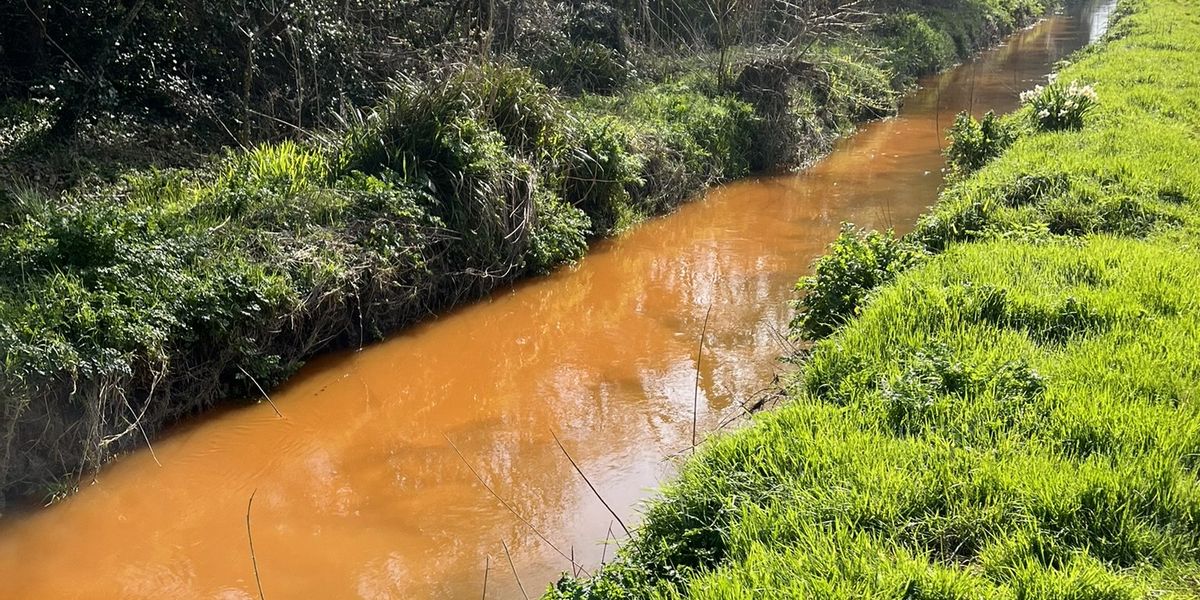
An urgent investigation has been launched, along with a strict warning, after a stream in a beloved English tourist hotspot turned a vivid orange.
Local residents in Perranporth, Cornwall, raised concerns about the sudden change, which initially baffled experts analysing the phenomenon.
Environment Agency officers attended Nansmellyn Marsh Nature Reserve and Bolingey Stream following reports of the striking contamination.
They strongly advised against swimming at Perranporth Beach, which has been affected by the discharge.
Perranzabuloe Parish Council shared updates from the agency on social media, confirming that investigators remain on site examining the incident’s source and environmental impact.
“We are aware and dealing with an ongoing pollution incident affecting the Bolingey stream and the bathing water at Perranporth,” they wrote.
“We have an officer on site investigating, but we are currently unsure of the source or the type of pollution. We can provide an update when we have further information.”
Initial uncertainty surrounded both the origin and nature of the pollutant, but officials subsequently identified the substance as iron ochre, a mineral component of iron ore.
A stream in Cornwall has turned orange, prompting an urgent investigation and warning from authorities
|
ENVIROMENTAL AGENCY
Whilst testing revealed no dangerous bacteria in the water, officials warned that heavy metals may be present in the orange substance.
Investigators are now seeking to understand why the natural filtration process failed on this occasion.
“The EA are investigating what has changed in the area, as the marshland usually filters this out,” the agency informed locals.
“There is no harmful bacteria, but it may carry heavy metals. This is affecting Perranporth Beach, so bathing is not advised.”
Authorties advised locals not to bather at Perranporth Beach
|
GETTY
The marshland typically acts as a filter, preventing iron ochre from reaching the stream and the beach, but something has changed in the area, disrupting this protective function.
It comes as genetic material capable of producing antibiotic-resistant superbugs has been identified in the United Kingdom’s largest lake.
Lough Neagh provides drinking water to approximately 40 per cent of Northern Ireland’s population.
Water samples collected by Watershed Investigations revealed genes that could confer immunity to multiple antibiotic classes.
The range from standard penicillins to carbapenems, medications reserved for treating life-threatening infections when all other options have been exhausted.
Alongside the resistance genes, investigators found markers indicating contamination from human, bovine and pig waste in the water samples.
Sewage and agricultural runoff create optimal conditions for superbugs to develop, introducing pathogens, antibiotic residues and resistant bacteria into waterways where they can combine and proliferate.
Roughly 30 per cent of Northern Ireland Water’s storm overflows discharge raw sewage into Lough Neagh, with 106 discharging directly and 618 indirectly via rivers.