
British BulletinBritish Bulletin
  • Home
  • News
  • Politics
  • Business
  • Entertainment
  • Lifestyle
  • Health
  • Sports
  • Tech & Science
  • Travel
  • Spotlight
  • More
    • Press Release
What's On

Phil Mickelson to miss Masters & take extended break from golf over family health matter

3 April 2026

Mysterious letter prompts police appeal into devastating house fire that saw mother and five children killed

3 April 2026

Ed Miliband to green light first major North Sea gas field in a decade amid mounting pressure

3 April 2026

Council tax warning as thousands miss out on 50 per cent discount because they don’t apply

3 April 2026

Tiger Woods: Police release body camera footage of golfer straight after Florida crash

3 April 2026
Facebook X (Twitter) Instagram
Web Stories
Facebook X (Twitter) Instagram
British Bulletin
Subscribe
  • Home
  • News
  • Politics
  • Business
  • Entertainment
  • Lifestyle
  • Health
  • Sports
  • Tech & Science
  • Travel
  • Spotlight
  • More
    • Press Release
British BulletinBritish Bulletin
Home » Rare ‘Sword Dragon’ dinosaur named after decades by researchers | Manchester News
News

Rare ‘Sword Dragon’ dinosaur named after decades by researchers | Manchester News

By britishbulletin.com10 October 20253 Mins Read
Rare ‘Sword Dragon’ dinosaur named after decades by researchers | Manchester News
Share
Facebook Twitter LinkedIn Pinterest Email
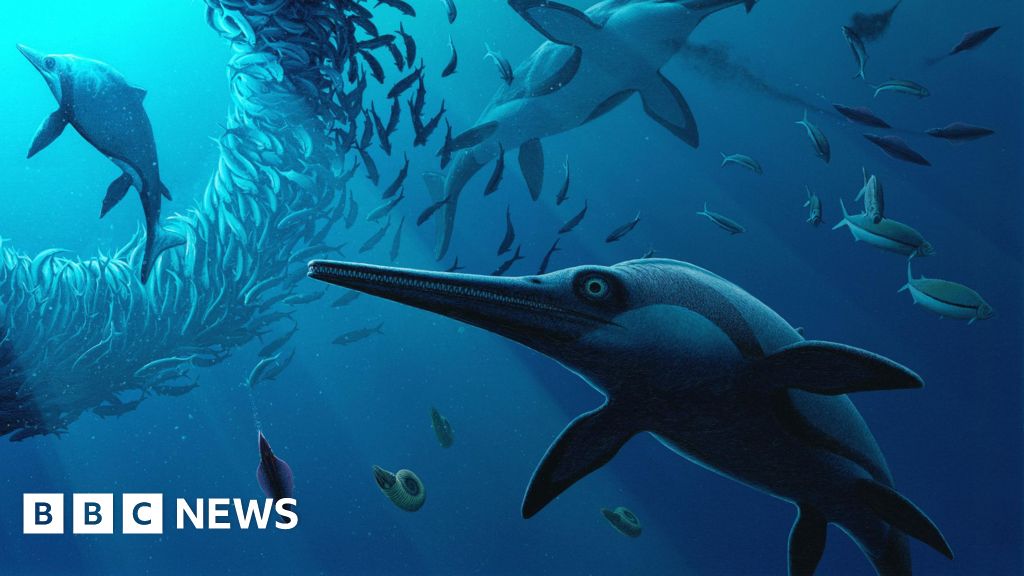
Bob Nicholls The Xiphodracon swimming underwater. It has a long spout and is surrounded by other Xiphodracons, and hundreds of fish.Bob Nicholls

The marine reptile is thought to have lived between 193-184 million years ago

Researchers have finally discovered the true identity of a huge dinosaur skeleton which lived in the seas hundreds of millions of years ago.

The team at the University of Manchester has been looking at an ichthyosaur fossil which was found on the south-west of England’s Jurassic Coast in 2001, and have named it Xiphodracon, or “Sword Dragon”.

The marine reptile is believed to have lived between 193-184 million years ago, during the Pliensbachian era.

The University of Manchester described the Xiphodracon as “a missing piece” from the ichthyosaur evolutionary record.

“I remember seeing the skeleton for the first time in 2016,” said Dr Dean Lomax, from the University of Manchester.

“Back then, I knew it was unusual, but I did not expect it to play such a pivotal role in helping to fill a gap in our understanding.”

Dr Dean Lomax Dr Dean Lomax and Professor Judy Massare standing in front of the Xiphodracon which is laying on a table. Dean has short dark hair and is wearing a chequered shirt, and black t-shirt. Judy has short grey hair and is wearing glasses, as well as a chequered shirt.Dr Dean Lomax

Dr Dean Lomax and Professor Judy Massare have both been working to identify the skeleton

Dr Lomax added: “This time is pretty crucial for ichthyosaurs as several families went extinct and new families emerged, yet Xiphodracon is something you might call a missing piece of the ichthyosaur puzzle.”

The skeleton, found near Golden Cap, Dorset, includes a skull with enormous eye socket and a long sword-like snout.

Scientists say the animal would have been about three metres long and would have eaten fish and squid.

It is believed to be the world’s most complete prehistoric reptile from the Pliensbachian period.

Unanswered questions

Professor Judy Massare, an Ichthyosaur expert from State University of New York, US, praised the update but said there are still questions around the ichthyosaur species.

“Thousands of complete or nearly complete ichthyosaur skeletons are known from before and after the Pliensbachian.

“Clearly, a major change in species diversity occurred sometime in the Pliensbachian.”

She added: “Xiphodracon helps to determine when the change occurred, but we still don’t know why.”

Dr Lomax, whose new book The Secret Lives of Dinosaurs has been endorsed by the Guns N’ Roses guitarist, Slash, said: “One of the coolest things about identifying a new species is that you get to name it.

“We opted for Xiphodracon because of the long, sword-like snout, and dracon in reference to ichthyosaurs being referred to as “sea dragons” for over 200 years,” he said.

He explained the “xipho” portion of the title has been taken from the Greek word for sword, xiphos, and “dracon” comes from the Greek and Latin word for dragon.

Share. Facebook Twitter Pinterest LinkedIn Tumblr Email

Keep Reading

Mysterious letter prompts police appeal into devastating house fire that saw mother and five children killed

Bangladeshi man sentenced to psychiatric hospital detention after attempting to kidnap two children from Cardiff park

Firefighters rush to save beloved local pub after blaze breaks out on decking

Six police officers face sack after stopping teenage e-bike rider

Jailed illegal immigrant wins right to stay in Britain as deportation would be ‘harsh’ on son

Litter picking group started in Britain aims to collect ONE MILLION bags filled with rubbish worldwide

Dorset pub launches urgent appeal for beloved badger after drunken thief accused of nicking local icon

Backshall overjoyed at rare sighting of orcas | UK News

Pressure mounts on Ed Miliband after SNP softens stance on North Sea oil

Editors Picks

Mysterious letter prompts police appeal into devastating house fire that saw mother and five children killed

3 April 2026

Ed Miliband to green light first major North Sea gas field in a decade amid mounting pressure

3 April 2026

Council tax warning as thousands miss out on 50 per cent discount because they don’t apply

3 April 2026

Tiger Woods: Police release body camera footage of golfer straight after Florida crash

3 April 2026

Subscribe to News

Get the latest Brittan News and Updates directly to your inbox.

Latest News

Bangladeshi man sentenced to psychiatric hospital detention after attempting to kidnap two children from Cardiff park

3 April 2026

Britain to ‘comprehensively reject’ Iran’s shakedown of ships in Strait of Hormuz

3 April 2026

Oil prices surge 12% after Donald Trump threatens to bomb Iran ‘back to the Stone Age’

3 April 2026
Facebook X (Twitter) Pinterest TikTok Instagram
© 2026 British Bulletin. All Rights Reserved.
  • Privacy Policy
  • Terms
  • Advertise
  • Contact

Type above and press Enter to search. Press Esc to cancel.