
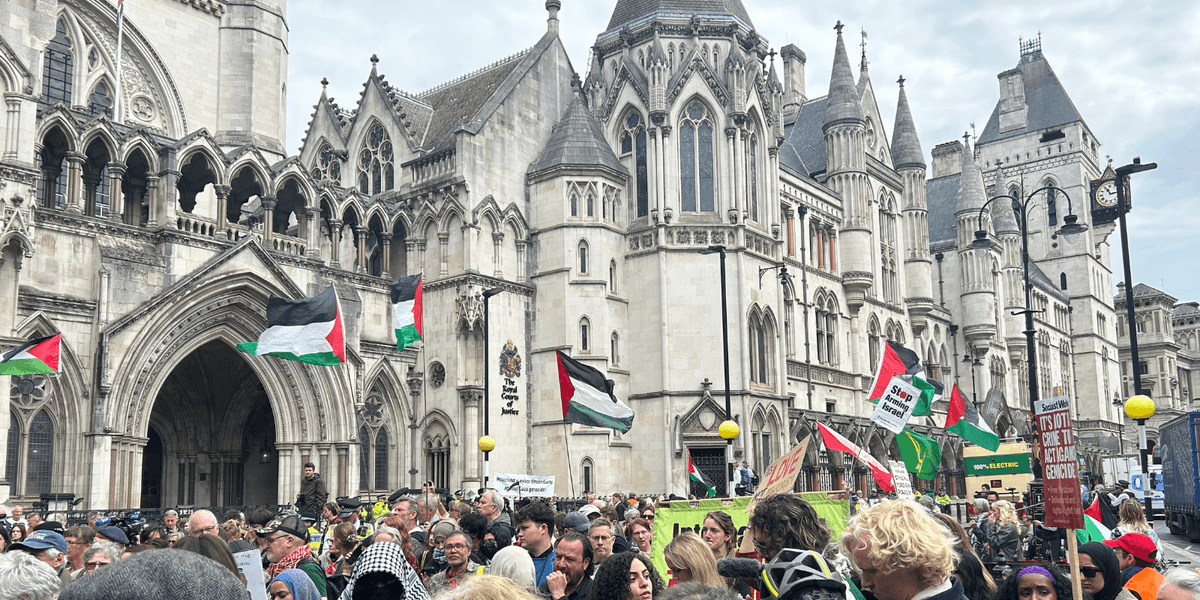
The Home Office’s decision to ban Palestine Action as a terror group was lawful, the Court of Appeal has declared.
Earlier this year, three judges claimed the decision to proscribe the group was “unlawful” and Yvette Cooper’s ban on the organisation should be reversed.
The legal challenge was brought before the court by the organisation’s co-founder, Huda Ammori.
The ban, which came into force on July 5, made membership of, or support for, the organisation a criminal offence with a sentence of up to 14 years in prison.
It has remained in place while the Home Office battled the legal challenge launched in February.
Shabana Mahmood’s department argued that criminal sanctions for dealing with the activists were “insufficient” after the group ramped up protest efforts.
Earlier today, five of Britain’s top judges sided with the Government and ruled that the decision to ban the group was lawful.
Lady Chief Justice Baroness Carr said that any comparisons to historical groups, such as the suffragettes, were “seriously flawed”.
Lady Chief Justice Baroness Carr made the ruling this morning
|
PA
She added that the High Court had “materially understated the position” when considering how much latitude the Home Secretary had when making the decision last July.
Lady Carr said that Palestine Action’s “campaign was escalating and was not being pursued with any restraint”.
She described the group as a “covert organisation which avoids the detection and prosecution of those using violence to destroy property and cause injury”.
Britain’s chief judge then declared: “The proscription decision was consistent with the Home Secretary’s proscription policy and was proportionate. It was not unlawful.”
PALESTINE ACTION – LATEST:
Palestine Action supports sat outside the court
|
PA
Lady Carr, alongside Sir Geoffrey Vos, Lord Justice Edis, Lord Justice Lewis and Lady Justice Whipple, said: “There is a distinction between the expression of an opinion or belief that is supportive of the objective of an organisation… and an expression of an opinion or belief that is supportive of an organisation itself.”
For the Home Office, Sir James Eadie KC said the “line between criminality, sometimes violent criminality, and terrorism is not a bright one”.
He argued criminal law had “demonstrably failed” to deter campaigners from ploughing on with their activities.
Fighting for Ms Ammori’s case, Raza Husain KC complained the ban on the protest group fuelled a “culture of fear” for those protesting about Palestine.
Since the ban was implemented, hundreds of campaigners across the UK have been arrested for donning badges and t-shirts backing the organisation.
On Friday, a Palestine Action activist who hit a police officer with a sledgehammer has been sentenced to seven years and eight months in prison.
Later that night, Green Party leader Zack Polanski suggested a pro-Palestine activist who broke a police officer’s spine with a sledgehammer should not go to prison.
Mr Polanski described the custodial sentence handed to Samuel Corner, 23, as “gut-wrenching” after the ex-Oxford student was banged up.