
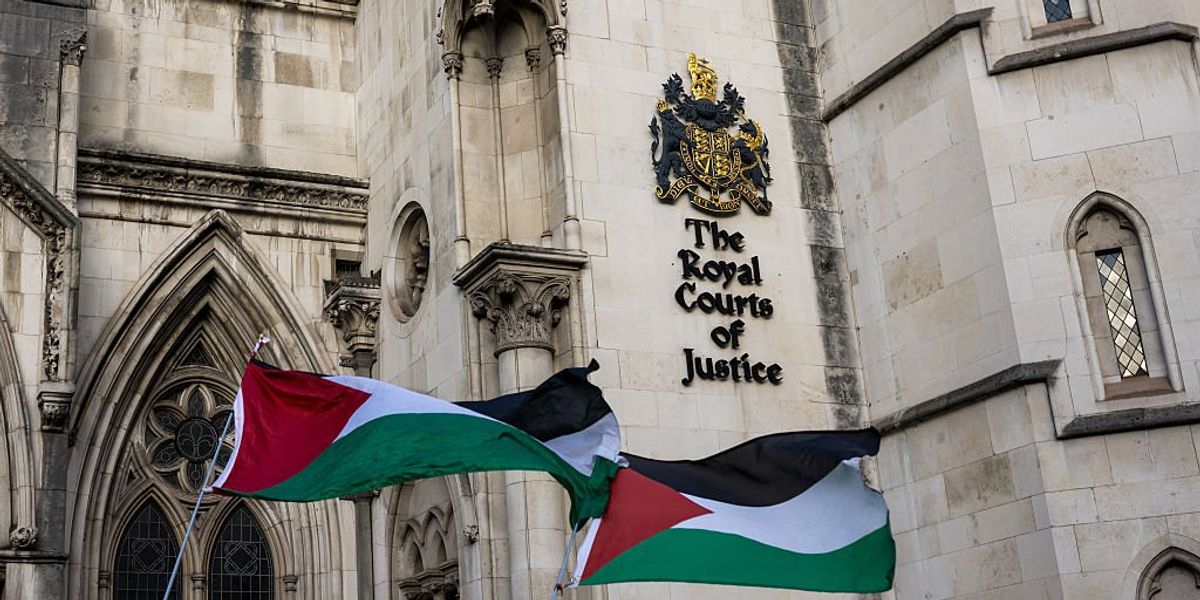
The co-founder of Palestine Action has won a High Court challenge over the ban of the organisation as a terror group on two grounds.
Huda Ammori had taken legal action against the department over the then-home secretary Yvette Cooper’s decision to proscribe the group under the Terrorism Act 2000.
The ban, which began on July 5 last year, made membership of, or support for, the direct-action group a criminal offence punishable by up to 14 years in prison.
At a hearing late last year, barristers for Ms Ammori told the court that the decision to ban the group was unlawful and should be quashed, with Palestine Action being the first “direct-action civil disobedience organisation that does not advocate for violence” to be proscribed as a terrorist group.
The group remains banned as a terror group to allow further arguments and the Government time to consider an appeal.
About a hundred people gathered outside the High Court building in central London, cheering and chanting “Free Palestine” after the news broke.
Ms Ammori said: “This is a monumental victory both for our fundamental freedoms here in Britain and in the struggle for freedom for the Palestinian people, striking down a decision that will forever be remembered as one of the most extreme attacks on free speech in recent British history.
“Palestine Action is the first civil disobedience organisation that does not advocate for violence to be proscribed by the British Government as a ‘terrorist’ group, in a Trumpian abuse of power which would have seen this Labour Government proscribe the Suffragettes.
Protests were held outside the Royal Courts of Justice
|
GETTY
She continued: “This ban was unlawful, resulting in the unlawful arrest of nearly 3,000 people, among them priests, vicars, former magistrates and retired doctors, under terrorism laws for simply sitting in silence while holding signs reading: ‘I oppose genocide I support Palestine Action’.”
In a summary of the High Court’s decision, Dame Victoria Sharp said: “The court considered that the proscription of Palestine Action was disproportionate.
“A very small number of Palestine Action’s activities amounted to acts of terrorism within the definition of section 1 of the 2000 Act. For these, and for Palestine Action’s other criminal activities, the general criminal law remains available.
“The nature and scale of Palestine Action’s activities falling within the definition of terrorism had not yet reached the level, scale and persistence to warrant proscription.”
Protesters celebrated outside the High Court
|
GETTY
Home Secretary, Shabana Mahmood said she was “disappointed” by the Court’s decision.,
She said: “The proscription of Palestine Action followed a rigorous and evidence-based decision-making process, endorsed by Parliament.
“The proscription does not prevent peaceful protest in support of the Palestinian cause, another point on which the Court agrees.
“As a former Lord Chancellor, I have the deepest respect for our judiciary. Home Secretaries must however retain the ability to take action to protect our national security and keep the public safe. I intend to fight this judgment in the Court of Appeal.”
Demonstrators gather outside the High Court during a ruling on whether the government’s ban of Palestine Action was unlawful o
|
GETTY
Sally Rooney had pledged to use money from the BBC to fund Palestine Action, a proscribed terror organisation
| GETTY
Ms Ammori began her legal challenge against the decision in June before failing in a last-minute bid on July 4 to block the ban from taking effect.
In October, the Home Office lost a Court of Appeal bid to block the challenge from proceeding, with judges dismissing the department’s argument that Ms Ammori should challenge the decision through the Proscribed Organisations Appeal Commission, rather than at the High Court.
Opening the full hearing of the challenge in November, Raza Husain KC, for Ms Ammori, told the High Court that there had been more than 2,000 arrests after Palestine Action’s proscription, including “priests, teachers, pensioners, retired British Army officers” and an “81-year-old former magistrates.”
The court also heard written evidence from Normal People author Sally Rooney in support of the challenge, after she previously said she would donate earnings from her books and BBC adaptations of novels to Palestine Action.
Ms Rooney said it was “unclear” whether any UK company can make payments to her under anti-terror laws and that if she was prevented from profiting from her work, her income would be “enormously restricted.”
The Irish writer also said it is “almost certain” she cannot publish or produce new work in the UK while the ban remains in force.
Protesters celebrating outside the High Court
|
REUTERS
Green Party leader Zack Polanski has called for charges against protesters who supported Palestine Action to be dropped as he welcomed today’s decision.
He said: “The court has ruled that the Government’s authoritarian ban on Palestine Action was unlawful. Now it is time for the Government to stop criminalising the people protesting a genocide, and start ending the UK’s complicity.
“Over 2,700 people have so far been arrested for holding a sign opposing genocide and the proscription of Palestine Action.
“Those already charged should have those charges dropped, and the Crown Prosecution (Service) should discontinue action against all those arrested.”