
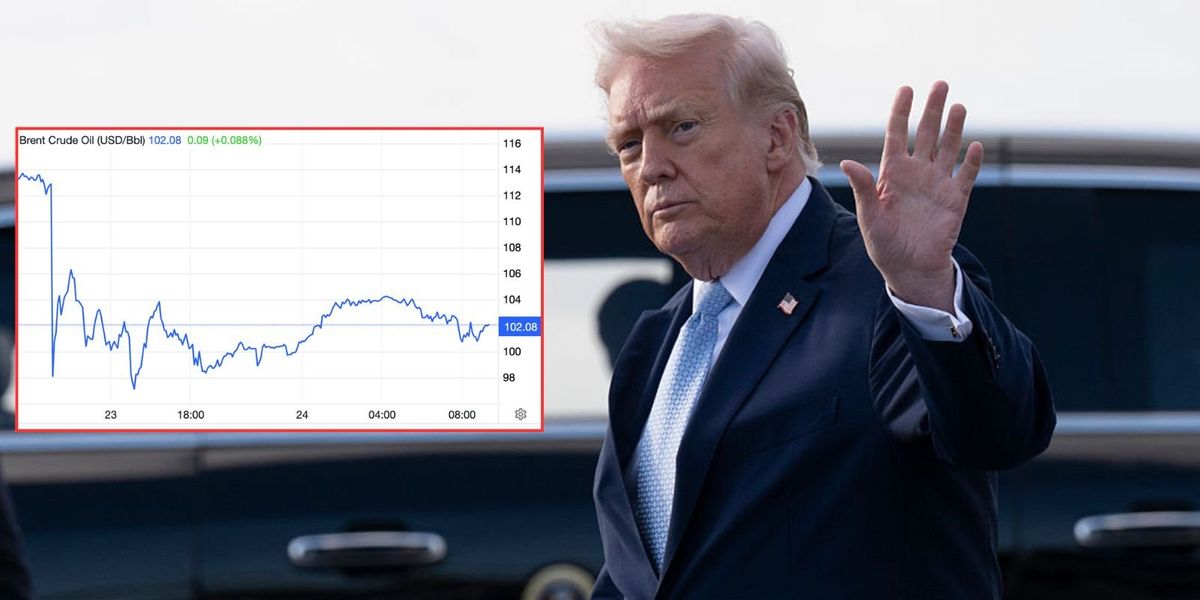
Brent crude surged back above the $100 mark on March 24, climbing four per cent to reach $103.94 per barrel in Asian trading.
The recovery follows a plunge of more than 10 per cent the previous day, when markets initially reacted to Donald Trump announcing he had postponed threatened military action against Iranian energy facilities.
Conflicting accounts from Washington and Tehran over whether diplomatic discussions have taken place continue to fuel uncertainty in global energy markets.
Mr Trump said the two nations had engaged in “productive” exchanges regarding a potential resolution, but Iranian officials dismissed these claims as market manipulation.
The volatility reflects ongoing tensions since the US and Israel launched military operations against Iran on February 28.
Mr Trump told reporters that the Strait of Hormuz could be “open very soon” if diplomatic efforts prove successful.
He also said the strategic waterway could be “jointly controlled” by himself and “whoever the next Ayatollah” is, despite Tehran having already announced Mojtaba Khamenei as the Islamic Republic’s new Supreme Leader.
Iran’s foreign ministry rejected Washington’s claims, stating no communications had taken place either directly or through intermediaries.
Brent crude tops $100 again as Iran tensions fuel market volatility
|
GETTY/Trading Economics
Over the weekend, Mr Trump had warned he would “obliterate” Iranian power plants unless the shipping route was reopened within 48 hours.
Tehran responded by publishing a list of power stations and energy facilities across the Gulf region it said would be targeted in retaliation.
Reports emerged on March 23 of strikes damaging two Iranian gas facilities, though the timing relative to the announced pause in military action remains unclear.
A gas pressure regulation station in Isfahan and a pipeline supplying the Khorramshahr power plant were both reported to have been hit.
The President set a deadline last night for the Strait of Hormuz to reopen
|
GETTY
Benjamin Netanyahu indicated Israel would maintain military pressure despite any US diplomatic efforts.
Mr Netanyahu said his “friend” Mr Trump is seeking to “leverage the massive achievements of the IDF and the US military” in potential negotiations, while Israel is “continuing to strike” Iran and Lebanon.
His comments highlight the complexity of the situation, with military operations continuing alongside diplomatic signals from Washington.
Asian stock markets showed relative stability on March 24 despite recent turbulence linked to the conflict.
Japan’s Nikkei 225 rose 0.8 per cent, Hong Kong’s Hang Seng increased 1.6 per cent, and South Korea’s Kospi climbed 2.2 per cent in morning trading.
Commodity markets as of 9:24am
|
Trading Economics
These markets had fallen sharply on March 23 given the region’s reliance on oil and gas shipments through the Strait of Hormuz.
Iran has effectively blocked the waterway since hostilities began on February 28, disrupting around a fifth of global oil and liquefied natural gas flows.
Governments worldwide have taken steps to mitigate the impact of rising energy costs and supply disruption.
Washington has temporarily lifted sanctions on Russian and Iranian oil already in transit to address shortages.
China said on March 24 it would scale back planned fuel price increases to reduce pressure on motorists during the crisis.