
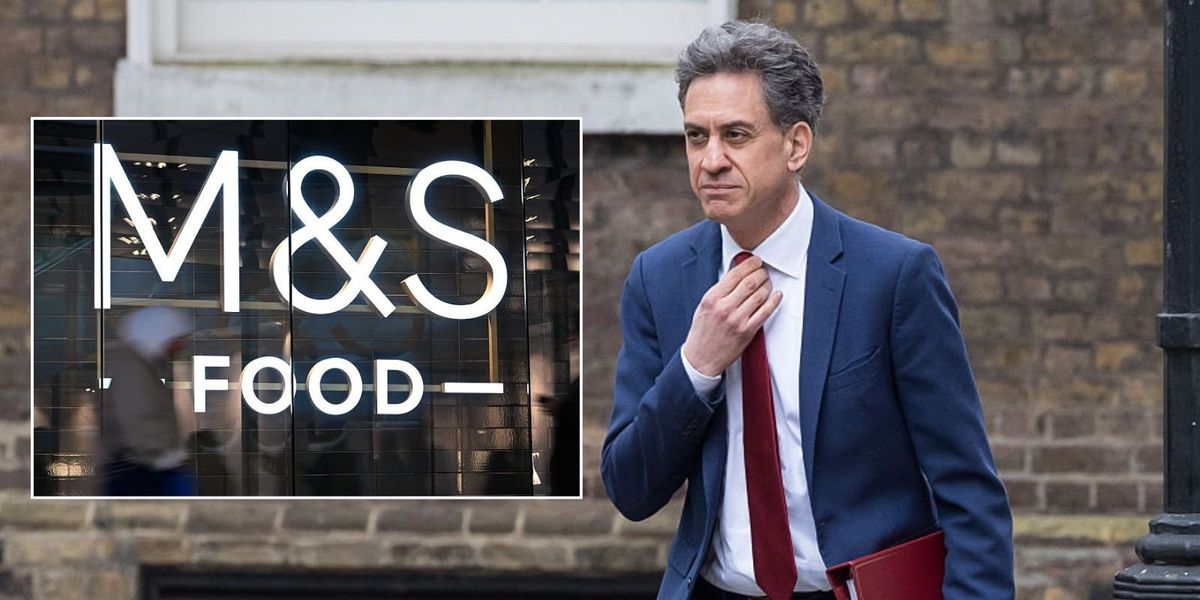
The head of Marks & Spencer has criticised the Labour Government over rising energy levies, warning they now account for more than half of the retailer’s total energy costs.
Chief executive Stuart Machin said policy‑driven charges on business energy bills have risen sharply in recent years.
“These are the tariffs that the Government place on our bills to fund their policies, and have nothing to do with the price of oil or gas,” he wrote in a LinkedIn post.
“They now make up over half our bill. It is not sustainable for UK businesses.”
Marks and Spencer boss criticises Labour over rising energy levies and business costs
|
GETTY
It comes as fellow retailers Next warned that the Iran conflict has already created a £15million cost hit, with higher fuel and air‑freight bills being absorbed internally for now but unlikely to stay contained if disruption drags on.
Lord Wolfson said the retailer can manage these pressures for around three months, after which persistent costs would start feeding through into higher prices for shoppers.
Even so, Next delivered stronger‑than‑expected annual results, lifting profits to £1.16billion and upgrading its outlook on the back of robust UK trading and better‑than‑planned full‑price sales.
International growth has been trimmed due to Middle East weakness, and the company cautioned that prolonged conflict could squeeze demand, raise costs and ultimately weigh on sales.
Since the conflict began, oil prices have climbed from around $70 to $100 a barrel, while natural gas costs have also risen sharply.
UK businesses face a range of policy‑related charges on their energy bills, including the renewables obligation, levies supporting clean‑energy schemes and feed‑in tariffs, network charges linked to net zero infrastructure upgrades, and the climate change levy on non‑domestic energy use.
Research from the CBI and Energy UK shows firms are paying 60 per cent more for gas and 70 per cent more for electricity than before the Ukraine crisis, despite wholesale prices falling.
Shadow chancellor Mel Stride criticised the Government’s economic approach, saying: “Rachel Reeves has ramped up borrowing, spending and taxes.
Shadow Chancellor Mel Stride has accused Ms Reeves of overtaxation on businesses | PARLIAMENTLIVE.TV
“As a result we have stagnant growth, while inflation, unemployment, the deficit and debt interest costs have all shot up.”
He added that “Ed Miliband’s net zero obsession” had increased reliance on imported energy rather than domestic North Sea supplies.
Britain’s limited gas storage capacity, enough for only a few days of consumption, leaves the country more vulnerable to global price shocks.
Chancellor Rachel Reeves acknowledged the conflict’s economic impact.
“The war in the Middle East is not one that we started, nor is it a war that we have joined. But it is a war that will have an impact on our country,” she said.
“In an uncertain world we have the right economic plan.”
The OECD has advised that any support measures should be targeted at vulnerable households and viable businesses rather than broad subsidies. Ms Reeves has said assistance will focus on lower‑income households.