
Household energy bills could rise by £160 if the war in Iran drags on, analysts warn.
A prolonged conflict would also hit UK growth and could see interest rates rise for the first time since 2023, according to forecasts.
The price of oil and gas has soared since bombing began at the weekend, sparking fears over inflation and the cost of living.
Researchers at Cornwall Insight said the rising prices could push average household bills to £1,801 year from July – a rise of £160.
Prices are set to fall from April thanks to the latest Ofgem price cap, which limits household gas and electricity costs.
But the analysts predicted a ten per cent rise in July because of the Middle East turmoil.
They said: “The immediate price rise reflects the overall surge in global gas markets, with the UK’s exposure to these as a net importer of the fuel feeding through to domestic bills.
“Price increases are not only felt through the gas bill but also in the electricity bill, due to the UK’s reliance on gas for power price setting.”
Britons have been told to brace for surging energy bills
|
GETTY
Any rise will depend on the length and extent of the war, they said, and July’s price cap will be based on average wholesale prices over a three month period.
“While the jump is a cause for concern, the assessment period for the July price cap has only just begun,” they said.
Speaking to the Energy Security and Net Zero Committee today (WEDS), Ofgem chief executive Jonathan Brearley told MPs: “Clearly, as we saw in the Russia Ukraine conflict, our gas supply cannot be separated from global events.
“It’s important to make clear that our energy supplies remain secure.
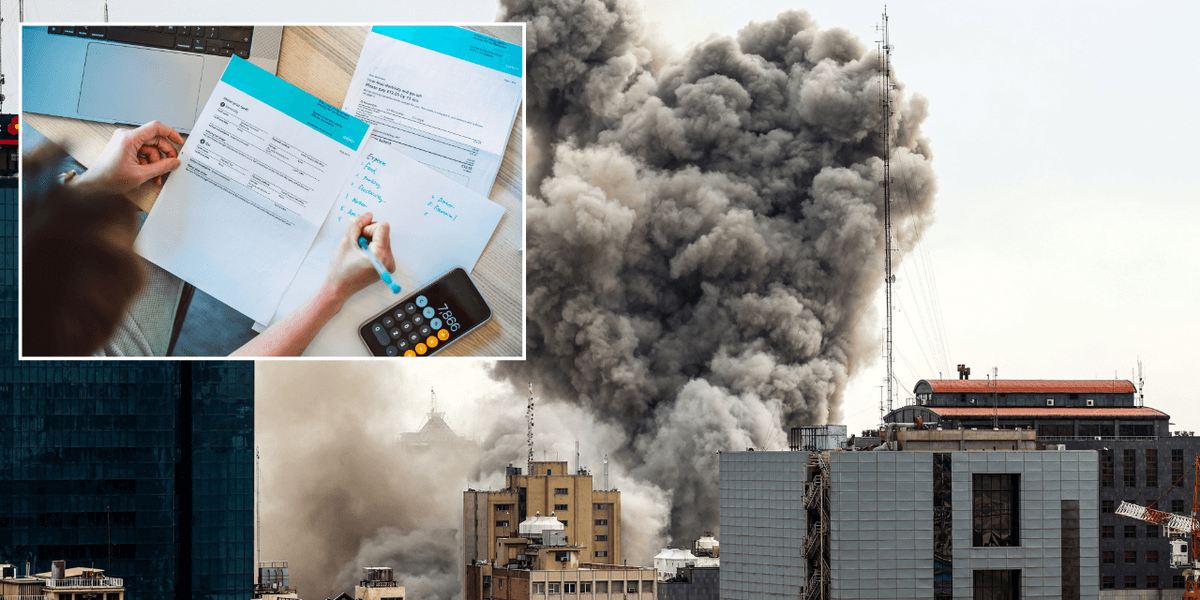
Smoke rises from a fire, as the Israel-Iran air war continues, in Tehran, Iran | REUTERS
“Britain continues to benefit from a diverse gas supply which provides the market with the flexibility it needs in times of disruption.
“In the short term until the end of June, customers will be on fixed tariffs or protected by the price cap.”
He added: “Although we remain at the early stages of this conflict, if the Strait of Hormuz remains closed for a prolonged period of time it is likely this will create significant upward pressure on prices that customers will pay for their gas and electricity.
“For example, in electricity, gas still sets the price for the majority of the time.
“Now I know already there is a great deal of speculation about the scale and extent of those price changes. But genuinely it is too early to tell.
“In my experience, gas traders find it extremely difficult to calibrate the sorts of risks we are facing, and therefore market projections are not a reliable guide to the future.”
Meanwhile, researchers at the National Institute of Economic and Social Research (NIESR) looked at the wider economic picture.
They predicted that if the conflict was short lived, the effect on UK GDP will be negligible. But if it drags on, inflation could rise by 0.7 per cent, with a 0.2 per cent additional hit to growth in 2026.
The conflict could have a knock-on effect
|
PAIn bad news for mortgages, this could see interest rates rise above four per cent.
The last interest rate rise came in summer 2003. Rates have either remained the same or fallen since then and currently stand at 3.75 per cent.
The NIESR team said: “The escalation in the Middle East has pushed oil and gas markets into risk mode again, with prices reacting to disruptions around the Strait of Hormuz, as shipping activity has been curtailed by Iran as a response to US and Israeli strikes.”
Forecasters looked at two scenarios, both assuming oil prices rose by a further 30 per cent, taking them above $100 a barrel.
The first scenario assumes that the price shock is transitory and comes down after a quarter. The second assumes that prices stay high for a year before they normalise.
The first case could see a 0.3 per cent rise in inflation, although the effect on the nation’s GDP would be minimal.
But a year of high prices would see inflation rise by 0.7 per cent and hit GDP by 0.2 per cent in 2026. “If the shock persists, the Bank of England could be forced to raise interest rates back above four per cent,” the authors say.
“We find much larger impacts on inflation and growth if the shock to oil and gas prices is more long-lasting.
“UK inflation in 2026 increases by approximately 0.7 percentage points relative to the baseline.
“Higher inflation and interest rates weigh on UK GDP, which decreases by 0.2 per cent in 2026.
“The impact on UK GDP from the increase in oil and gas prices and supply chain disruptions, should the war continue, intensifies in 2027, leading to a decrease of 0.3 per cent relative to the baseline.”
Chief Secretary to the Treasury James Murray said it was “early days” but that the Government was watching developments closely.
He said: “I can understand because people have been concerned about the cost of living for a long time, so when people see what they do on the news, they will wonder ‘what does this mean for us?’
“What I would say to people is that it’s early days in terms of what’s happening in the Middle East.
“We’re all very concerned about what’s happening and, as a Government, we’re monitoring very closely, but it is early days, and in terms of how people will experience their energy bills in the immediate future, they will see that reduction come through via the price cap on April 1.”
David Miles, of the Office for Budget Responsibility, pointed out that the increases in oil and gas were “nowhere near as large” as those seen after Russia launched its full-scale invasion of Ukraine four years ago.
But he said that previous predictions that inflation would fall have become “more uncertain” because of the energy price shock.
He said: “I think what will happen to inflation is particularly uncertain in the past few days.
“There have been very large increases in gas prices and oil prices.
“Our central expectation had been that inflation would fall back towards the Bank of England’s two per cent target early this year and will be around that level at the end of the year.
“There must be more uncertainty around that right now.”
Fuel prices for motorists have been rising since the weekend, said the RAC head of policy Simon Williams.
He said: “The average price of petrol has increased by nearly 2.5p a litre since Saturday and diesel by more than 3p on the back of oil surging above $81 a barrel – a price not seen since January last year.
“Providing oil stays around this level the average price of petrol shouldn’t really rise to more than 136p. Diesel, however, is increasing at a faster rate.”