
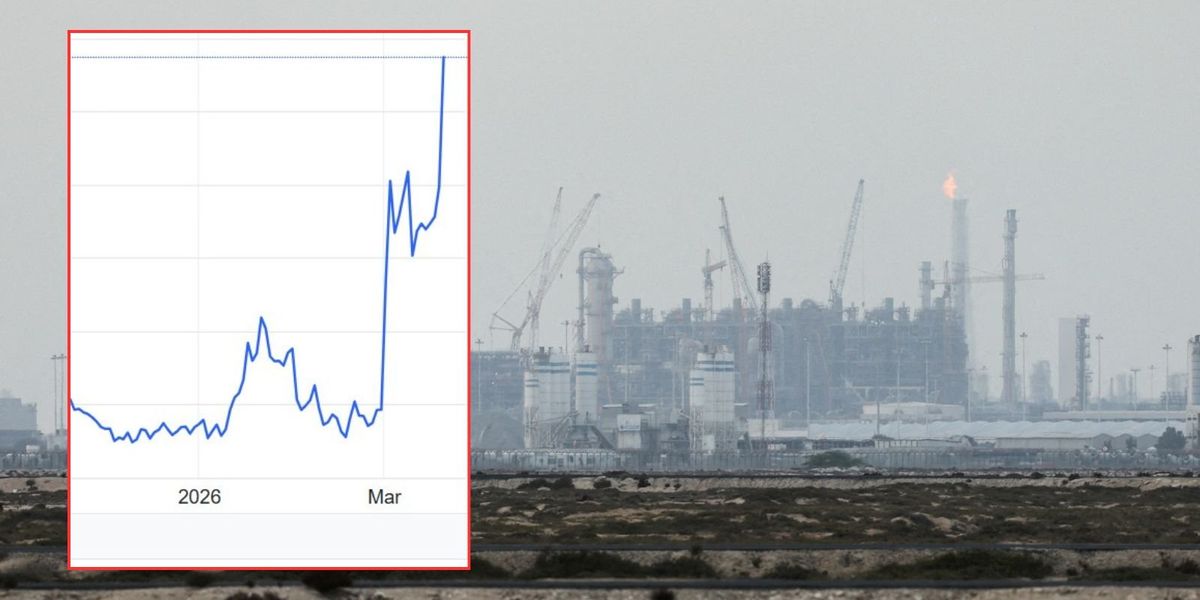
UK gas prices have surged by more than 20 per cent this morning as the US-Iran war continues to rage on in the Middle East.
Overnight, two waves of strikes from the Islamic Republic resulted in “extensive damage” at Qatar’s main gas hub, which many European countries are reliant on.
As of 7:54 am, UK gas prices were sitting at 173p per therm, which is up more than 24 per cent from yesterday.
Furthermore, the oil price is trading at around five per cent higher, close to $113 a barrel.
Gas prices have surged by more than 20 per cent in response to the US-Iran war
|
GETTY / REUTERS / TRADING ECONOMICS
Qatar’s state-run energy firm confirmed “extensive damage” had been caused after missile strikes on the Ras Laffan Industrial City on the country’s north coast on Wednesday caused damage to a gas-to-liquids facility.
Early this morning, the attacks caused “sizeable fires and extensive further damage” to several liquified natural gas facilities, QatarEnergy said in a statement.
Iran’s latest assault on the region came after reports Israel launched an attack against the regime’s South Pars gas field.
US President Donald Trump claimed that he “knew nothing” of Israel’s strike and that he did not want to authorise “this level of violence and destruction”, he also promised to “massively blow up the entirety” of South Pars if Qatar’s energy infrastructure is hit again.
British military crack team rushes to US to help Donald Trump reopen vital Strait of Hormuz
Donald Trump hit out at Israel for ‘violently lashing out’ after attacking an Iranian gas field | GETTY
Qatar’s state-backed energy company Qatar Energy had halted production of liquefied natural gas at its sites at the beginning of the month because of attacks on its facilities.
Kathleen Brooks, research director at XTB, said the escalation in the conflict was “spooking the market” and traders were predicting “hefty losses for stocks” when stock markets open.
She shared:M “This war looks far from over, and the energy crisis is shifting from a shipping crisis to a supply crisis. If Iran is targeting energy assets in the region, then the conflict gets more serious and the repercussions for a long-term energy price shock also start to play out in financial markets.”
Ms Brooks added that despite Mr Trump’s calls for Israel and Iran to stop targeting energy sites, “it will take a lot of positive sentiment and news flow to calm energy prices today”.
Susannah Streeter, the chief investment strategist at Wealth Club, said: “Fears of a sustained energy shock have resurfaced after the escalation in the Iran war sent oil and gas prices soaring.
“The prospect of a longer, more drawn-out conflict is in sharp focus, as both sides ratchet up attacks on energy infrastructure. Downbeat sentiment is spreading fast, with London’s Footsie opening around one per cent lower as investors assess the repercussions for the global economy.
“Brent crude remains highly volatile but has traded as high as $114 a barrel today, threatening to climb back towards recent scorching levels. Gas prices have surged by 25 per cent, reaching a range not seen since early January 2023.
“Warnings that oil could reach $150 a barrel have resurfaced. Israel’s attack on Iran’s gas fields has prompted retaliatory strikes on facilities in Qatar. Europe in particular is reliant on LNG exports from Qatar, as countries have been weaning themselves off dependence on Russia.”