
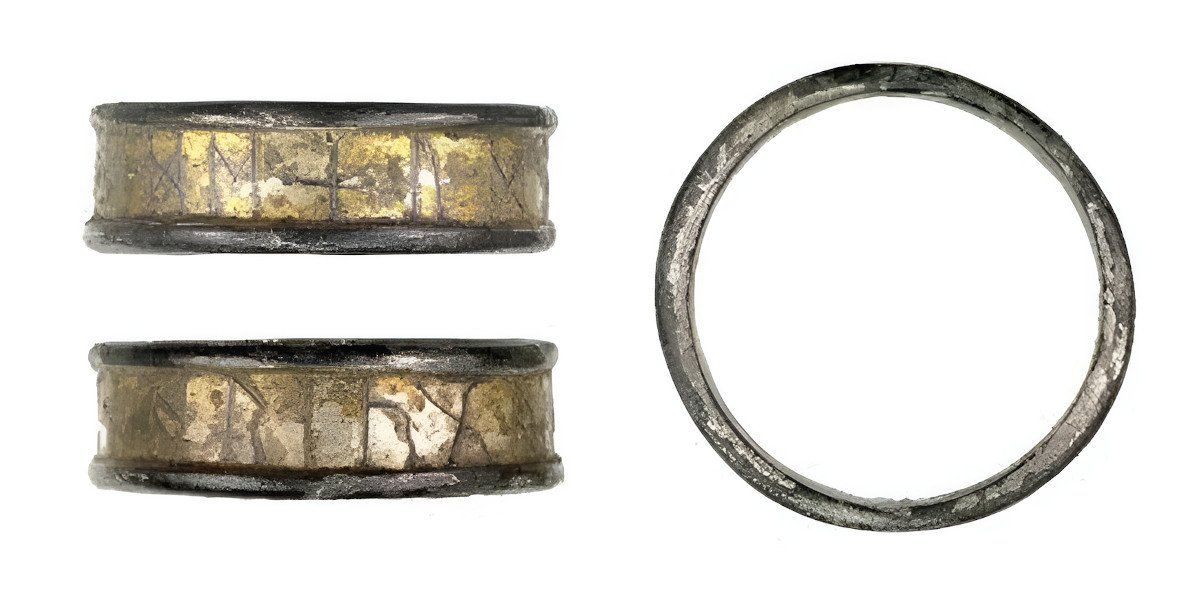
A metal detectorist from Boston has unearthed what archaeologists are calling one of the most remarkable discoveries ever made in Lincolnshire.
Rafal Wesolowski, 49, found the Anglo-Saxon gold ring adorned with runic inscriptions whilst searching a field in Quadring, South Holland, in May 2024.
“I didn’t know exactly what it was, but I knew immediately it was something special,” he said.
The history enthusiast, who took up detecting to connect with the past firsthand, described the moment of discovery as surreal.
“I remember standing there in the field, holding it in my hand, thinking ‘how is it possible that I am the first person to touch this again after more than a thousand years’?”
The artefact, which dates to more than a millennium ago, features 16 runic characters arranged from left to right around its surface.
Specialists believe the inscription may contain a personal name alongside the word “ring,” though its complete meaning remains undeciphered.
“For me, the idea that someone over a thousand years ago might have worn this ring, not just as jewellery, but as something meaningful or protective, is incredible,” Mr Wesolowski said.
A metal detectorist uncovered an Anglo-Saxon gold ring adorned with runic inscriptions
|
GETTY
Following his discovery, he reported the find to the Portable Antiquities Scheme, and researchers from the University of Nottingham subsequently confirmed both its early medieval origins and its archaeological significance.
Dr Lisa Brundle, finds liaison officer for the Portable Antiquities Scheme at Lincolnshire County Council, described the discovery as among “the most significant” archaeological finds ever recorded in the region.
The runic inscription may include the personal name Udnan, according to experts at the University of Nottingham.
“This places the piece within an exceptionally small group of inscribed early medieval rings known from Britain,” Dr Brundle said.
The find was described as ‘the most significant’ archaeological discovery ever recorded in the region
|
LINCOLNSHIRE COUNTY COUNCIL
She noted the ring “would have been a treasured possession” for its original owner.
It was therefore among only a handful of comparable examples, including one from Kingmoor in Cumbria, held at the British Museum.
Mr Wesolowski’s discovery was not an isolated find.
Additional artefacts recovered from the same location, including a late Anglo-Saxon buckle, point to a previously unknown early medieval settlement in the area.
Dr Brundle said the combined discoveries suggest “a community of considerable status” once inhabited the fen-edge landscape, potentially including a literate elite.
She predicted the find would “enrich our understanding and appreciation of the early medieval past” for future generations.
The ring has since been officially declared a treasure by the Coroner in Lincoln.
There is now hope that the Lincoln Museum will acquire the artefact.