
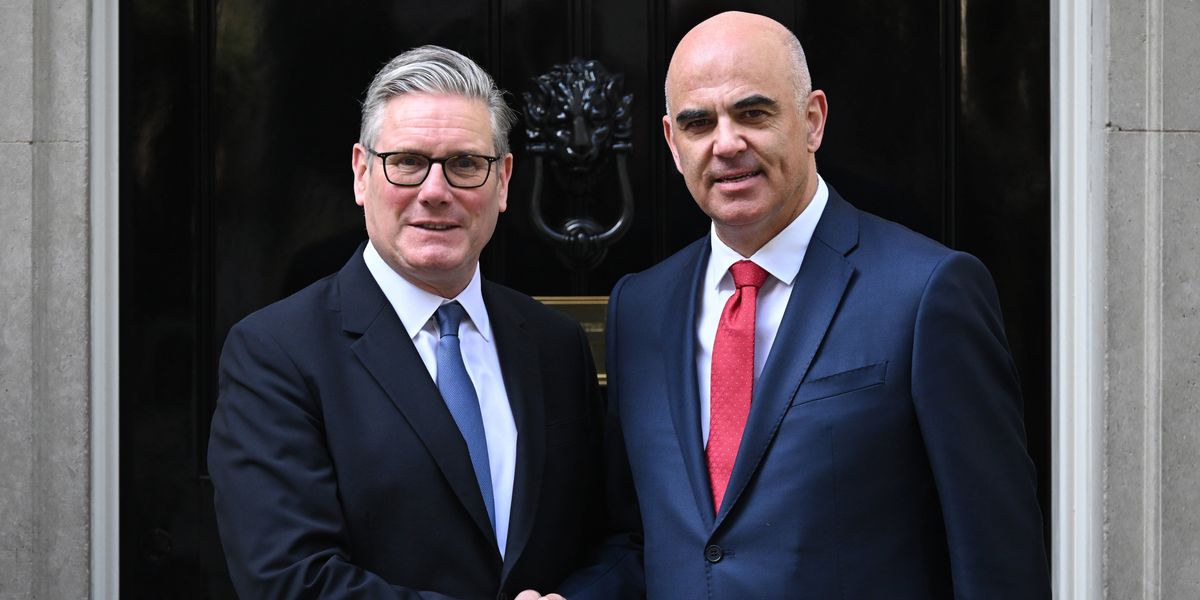
The head of the Council of Europe has said Britain’s concerns about migration must be taken seriously, as he held discussions with Sir Keir Starmer and David Lammy in London today regarding a contentious reinterpretation of the European Convention on Human Rights (ECHR).
Alain Berset, the organisation’s secretary-general, arrived in the capital for negotiations centred on granting member states greater flexibility over migration and deportation policies.
Mr Berset acknowledged British frustrations with the ECHR’s impact on immigration enforcement required serious attention.
“Clearly it is a sensitive discussion,” he told The Times. “That’s normal — the work is not easy.”
The proposed political declaration would urge both domestic courts and the European Court of Human Rights in Strasbourg to acknowledge nations’ “undeniable sovereign right” to manage their own borders.
Under the plan, Governments would gain expanded powers to remove foreign nationals who have committed serious offences.
Judges would also be encouraged to adopt a firmer stance when weighing claims based on family life protections and the prohibition against “inhuman or degrading” treatment.
The declaration aims to provide stronger legal foundations for offshore processing centres modelled on the Rwanda scheme, where asylum claims would be handled outside European territory.
Alain Berset has said the Council of Europe needs to listen to Britain’s concerns on immigration
|
GETTY
It would additionally address situations involving “instrumentalised” migration, such as Belarus’s orchestrated pushing of irregular migrants towards Poland, Lithuania and Latvia.
Negotiations on the declaration are understood to be “95 per cent” complete, with the remaining details expected to be settled at a Council of Europe summit in the Moldavian capital Chisinau next month.
Although the document would carry no legal force, similar political statements have previously wielded significant influence over judicial decisions.
The initiative represents an attempt to address growing unrest across the continent, with nine European nations having publicly demanded ECHR reform last year.
Alain Berset has said a new declaration is around ’95 per cent’ agreed upon
|
GETTY
Denmark and Italy led that coalition of dissatisfied states.
Within Britain, the pressure has been particularly acute, with both Reform and the Conservatives committing to withdraw from the convention entirely should they enter Downing Street.
However, polling suggests fewer than a third of voters back such a move.
Sir Keir Starmer’s Labour administration has opted to remain within the convention while pursuing changes from within the system.
Human rights organisations have responded to the Chisinau proposals with alarm.
Certain legal academics have described the plan as an “unprecedented regression” in protections afforded to migrants.
Amnesty International has cautioned against what it termed a “dangerous rollback” of safeguards.
Yet Mr Berset maintained European conversations around immigration had remained in a “comfortable” space for too long.
“We are still struggling with different positions, different views,” he commented, “but I’m strongly convinced that the best way to take those discussions forward is to debate, to try and find a convergence together.”
The secretary-general insisted it was time to confront disagreements openly rather than avoid difficult exchanges.
Mr Berset argued the human rights system must adapt to the realities confronting member states or risk undermining its own authority.
The Council of Europe, established in 1949 partly through Winston Churchill’s vision, created the ECHR as a foundation for democratic norms following the devastation of the Second World War.
The organisation now encompasses 46 member states and its convention substantially shapes British court rulings.
Mr Berset cautioned a British departure from the ECHR would mean surrendering the opportunity to influence “core values, European values, human rights, the rule of law and democracy” during a period when such principles require active defence.
“Let us address all the points where we have differences and let us find out what it means to address them, and how we can correct them,” he urged.