
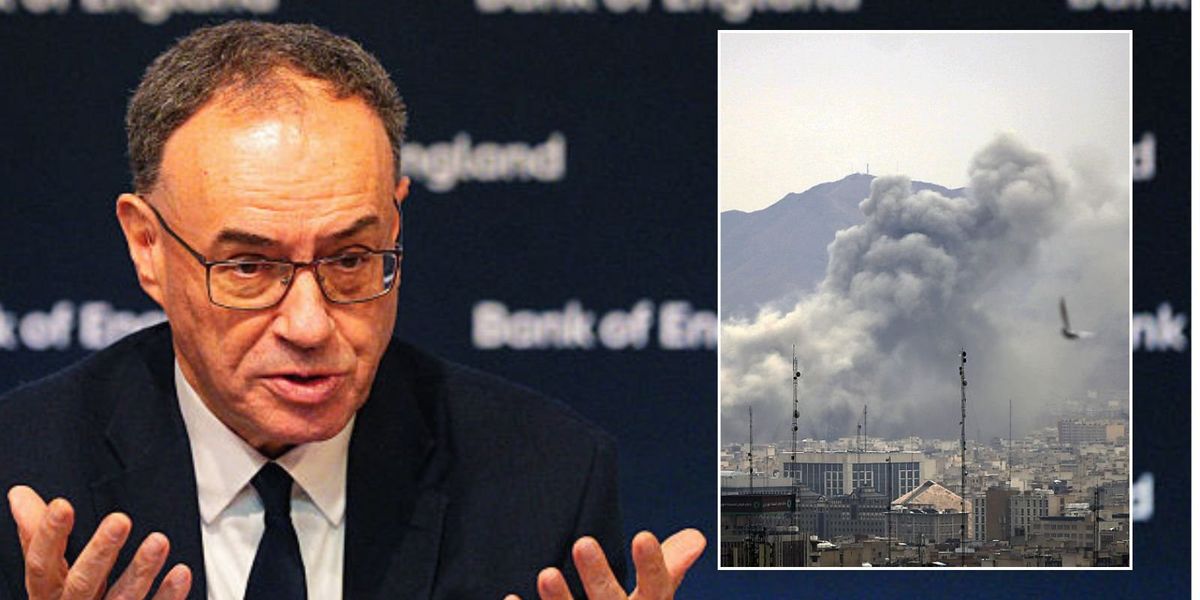
The Bank of England has voted to keep the UK’s base rate at 3.75 per cent as the ongoing war between the US-Iran war causes an “uncertain global backdrop” for the markets.
Prior to President Donald Trump and Israel’s decision to launch military action against the Islamic Republic, markets had priced in at least two rate cuts from the central bank in 2026.
In recent years, the Bank’s Monetary Policy Committee (MPC) has opted to raise the cost of borrowing to as high as 5.25 per cent in an effort to bring down the consumer price index (CPI) inflation.
As inflationary concerns have eased, committee members have voted to bring down the base rate to 3.75 per cent, but the recent spike in gas prices appears to have put a halt to cuts for the time being.
The Bank of England has opted to keep the base rate at its current level amid the ‘backdrop’ of the US-Iran war
|
GETTY
The base rate sets the cost of borrowing for businesses and consumers, determining the interest rates attached to mortgage products and savings accounts.
Unlike recent base rate decisions, all policymakers on the nine-person MPC voted unanimously in favour of the proposition to hold.
Following its decision, the Bank published in a statement: “Conflict in the Middle East has caused a significant increase in global energy and other commodity prices, which will affect households’ fuel and utility prices and have indirect effects via businesses’ costs.
“Prior to this, there had been continued disinflation in domestic prices and wages. CPI inflation will be higher in the near term as a result of the new shock to the economy.”
Bank of England interest rates over time | Bank of England
Is the Bank of England cutting interest rates fast enough? | GETTY
Bank of England governor Andrew Bailey added: “Large movements in energy prices have resulted from events in the Middle East and uncertainty over the duration of supply disruptions.
“Monetary policy cannot reverse this shock to supply. Its resolution depends on action taken at its source to restore the safe passage of shipping through the Strait of Hormuz. Monetary policy must, however, respond to the risk of a more persistent effect on UK CPI inflation.
“A prolonged disruption to the supply of oil, natural gas, and other commodities such as fertiliser and neon gas increases the upside risk to inflation. The recent experience of high inflation may also make households and businesses more sensitive to a new inflationary shock.
“At the same time, the starting point for this shock is a real economy with limited pricing power. Holding bank rate at this meeting is appropriate. I will be monitoring developments extremely closely and stand ready to act as necessary to ensure that inflation remains on track to meet the two per cent target in the medium term.”
Bank of England Governor Andrew Bailey | Getty Images
Today’s decision comes as a blow to borrowers, with many prospective homebuyers in the UK hoping to have taken advantage of more competitive mortgage rates later in the year.
Sarah Pennells, consumer finance specialist at Royal London said: “The Bank of England’s decision to keep interest rates on hold reflects the uncertain global backdrop.
“Until recently, a cut had been widely expected, but the conflict in the Middle East has heightened concerns about energy prices and the risk that inflation could stay higher for longer.
“That uncertainty has already fed through into the mortgage market. In the past week or so, hundreds of mortgage deals have been pulled, and average rates for fixed mortgages have edged up, making things more difficult for people coming to the end of their current fixed deal or trying to buy their first home.
“Anyone looking for a new mortgage deal would be well advised to speak to an independent mortgage broker, who can help navigate a fast-changing market and identify mortgages that may not be available directly from lenders.”