
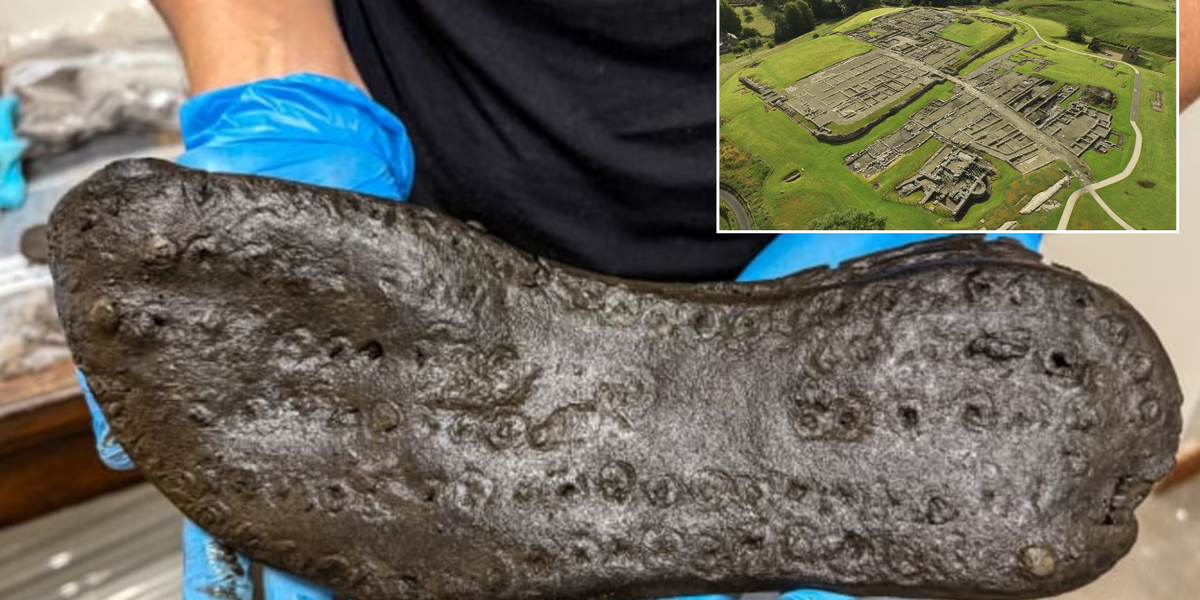
An archaeology breakthrough near Hadrian’s Wall has left scientists feeling “baffled”.
Digs at the Roman fort of Magna in Northumberland have yielded an extraordinary collection of leather footwear significantly larger than typical Roman finds.
The preserved shoes, discovered in waterlogged soil conditions, measure up to 12.8 inches in length.
This equates to modern UK sizes 12 to 14, a striking departure from standard Roman military footwear.
Vindolanda Charitable Trust
|
The preserved shoes, discovered in waterlogged soil conditions, measure up to 12.8 inches in length
The exceptional preservation resulted from the area’s oxygen-poor, wet environment, which has protected organic materials for nearly two millennia.
The size disparity has prompted extensive discussion amongst researchers about the fort’s inhabitants and their specific requirements.
The findings present a marked contrast to discoveries at the nearby Vindolanda site, where extensive excavations have produced thousands of Roman shoes.
At Vindolanda, footwear typically measures between 9.5 and 10.2 inches, corresponding to contemporary UK sizes seven to eight.
Remarkably, fewer than 0.5 per cent of Vindolanda’s shoe collection falls into the large category.
The Magna excavations, conducted by the Vindolanda Trust, have revealed a substantially higher proportion of oversized footwear amongst their finds.
LATEST DEVELOPMENTS:
Vindolanda Charitable Trust
|
The Roman fort of Magna in Northumberland
This significant variation between two proximate Roman military sites has generated considerable interest regarding the distinct populations stationed at each location.
Emma Frame, the senior archaeologist overseeing the Magna excavations, proposes that the footwear might indicate “potentially taller” individuals amongst the fort’s population.
Alternative explanations have emerged for the oversized shoes.
One theory suggests they served as winter boots, accommodating extra padding for Syrian archers stationed at Magna who were unaccustomed to Britain’s harsh climate.
Supporting evidence includes a preserved letter from Vindolanda mentioning gifts of socks and undergarments sent to soldiers for warmth.
Another hypothesis proposes medical applications, with the large shoes potentially designed for individuals with swollen feet or those requiring bandages and dressings.
Tim Penn, a lecturer in Roman and Late Antique Material Culture at the University of Reading, challenges the notion that archaeologists are “baffled” by such discoveries.
He argues that researchers are systematically evaluating various hypotheses using evidence-based analysis.
Penn likens archaeological work to assembling a jigsaw puzzle with numerous missing pieces, particularly the crucial edge pieces.
The fragmentary nature of ancient evidence means multiple interpretations must be considered until additional findings emerge.
Rather than expressing bewilderment, archaeologists are applying rigorous methodology to understand why this particular Roman fort housed individuals requiring such unusually large footwear.