
British BulletinBritish Bulletin
  • Home
  • News
  • Politics
  • Business
  • Entertainment
  • Lifestyle
  • Health
  • Sports
  • Tech & Science
  • Travel
  • Spotlight
  • More
    • Press Release
What's On

Olympic champion Katy Marchant retires from cycling

28 September 2026

Andy Burnham urged to scrap state pension triple lock to pay for social care

28 September 2026

Police block Orange Order from controversial parade route | UK News

28 September 2026

England cricket: Brendon McCullum proposes 50-over warm-ups – how are side shaping up for World Cup?

28 September 2026

Nature spaces ‘need to be right next to where people live’ | Manchester News

28 September 2026
Facebook X (Twitter) Instagram
Web Stories
Facebook X (Twitter) Instagram
British Bulletin
Subscribe
  • Home
  • News
  • Politics
  • Business
  • Entertainment
  • Lifestyle
  • Health
  • Sports
  • Tech & Science
  • Travel
  • Spotlight
  • More
    • Press Release
British BulletinBritish Bulletin
Home » Commonwealth Games 2026: How are points scored in artistic gymnastics?
Sports

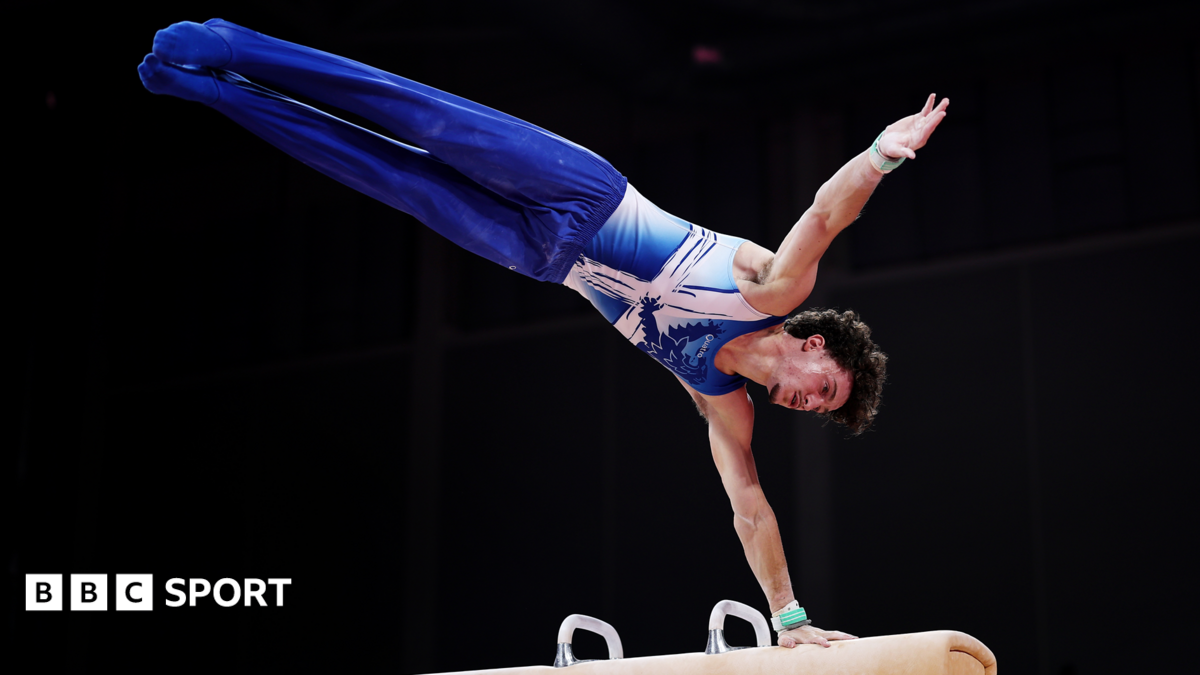
Commonwealth Games 2026: How are points scored in artistic gymnastics?

By britishbulletin.com27 July 20263 Mins Read
Commonwealth Games 2026: How are points scored in artistic gymnastics?
Share
Facebook Twitter LinkedIn Pinterest Email

Like many judged sports, there are two main factors to balance when scoring an artistic gymnastics routine – difficulty and execution.

The two scales being used to allocate points are the ‘D-score’ for difficulty and the ‘E-score’ for execution, each having a dedicated panel of multinational judges who have been approved by the International Gymnastics Federation (FIG).

The scores produced by each of these panels – following any ‘neutral deductions’ – are then combined to give the gymnast a final score, either as a standalone result for the individual events or a combined score across multiple events for the all-around contests.

The biggest difference between how the two scores are decided upon is that the Difficulty Score starts at zero and racks up depending on how challenging the routine is deemed to be – with no upper limit to the scoring.

However, the question with E-Scores should perhaps be ‘how are points lost’ instead of ‘how are points scored’, as each athletes begins their routine with a perfect 10 which decreases as mistakes are made.

Points are deducted in increments of 0.1, 0.3, 0.5:

  • 0.1 points deducted for small errors such as a minor loss of balance

  • 0.3 points deducted for medium errors like significant loss of balance

  • 0.5 points deducted for large errors – deep squats on landing an example

  • 1.0 point deducted for major errors such as falls

D-Scores arise from predetermined values set for different elements in the FIG Code of Points, set from difficulty ratings A through to H-J.

For example, the Code of Points allocates 0.1 points for A-grade ‘basic’ skills such as a forward roll or handstand, and up to 0.8-1.0 points for H-J grade ‘exceptional’ named pioneering moves.

There are also difficulty points available for the composition of the routine showing balance of skill types, and connection points for how well the skills are linked together to produce a flowing display.

The only exception to the dual E-Score and D-Score system is the vault event, where each routine has a pre-determined D-Score and so only the E-Score is judged.

Neutral deductions are applied to the combined E and D-Scores, and take into account errors unrelated to the routine itself.

These include stepping out of bounds, going over allocated routine time, or outfit violations.

For a medal-winning result, athletes will be aiming for points in at least the 14s and into the 15s.

A world-class routine may reach into the high 15s or low 16s.

For example, during her dominance of the 2016 Olympics, US gymnast Simone Biles scored 15.866 on vault, 14.966 on uneven bars, 15.433 on balance beam, and 15.933 on floor exercise to produce an overall score of 62.198 for the gold medal, which was more than two points clear of the runner-up.

Share. Facebook Twitter Pinterest LinkedIn Tumblr Email

Keep Reading

Olympic champion Katy Marchant retires from cycling

England cricket: Brendon McCullum proposes 50-over warm-ups – how are side shaping up for World Cup?

Laver Cup: Alexander Zverev beats Learner Tien to seal victory for Team Europe

England vs Sri Lanka highlights, third ODI: Hosts win by 223 runs

Nations League: Bruno Fernandes, Cody Gakpo and Patrick Dorgu injured on international duty

Chelsea: Resilience is back so can Blues regain the WSL title this season?

Netball World Cup: Northern Ireland qualifying ‘surreal’ – Caroline O’Hanlon

Israel v Republic of Ireland in Nations League: No handshakes between players before fixture

United States complete thrilling comeback to retain Presidents Cup

Editors Picks

Andy Burnham urged to scrap state pension triple lock to pay for social care

28 September 2026

Police block Orange Order from controversial parade route | UK News

28 September 2026

England cricket: Brendon McCullum proposes 50-over warm-ups – how are side shaping up for World Cup?

28 September 2026

Nature spaces ‘need to be right next to where people live’ | Manchester News

28 September 2026

Subscribe to News

Get the latest Brittan News and Updates directly to your inbox.

Latest News

Ranulph Fiennes’s wife ‘stopped the King trying to contact national treasure explorer’

28 September 2026

Dolly Parton fans left ‘in tears’ as Kacey Musgraves delivers ‘beautiful’ MTV VMAs tribute to music legend

28 September 2026

What we know about RAF Fairford incident and counter-terror probe | UK News

28 September 2026
Facebook X (Twitter) Pinterest TikTok Instagram
© 2026 British Bulletin. All Rights Reserved.
  • Privacy Policy
  • Terms
  • Advertise
  • Contact

Type above and press Enter to search. Press Esc to cancel.