
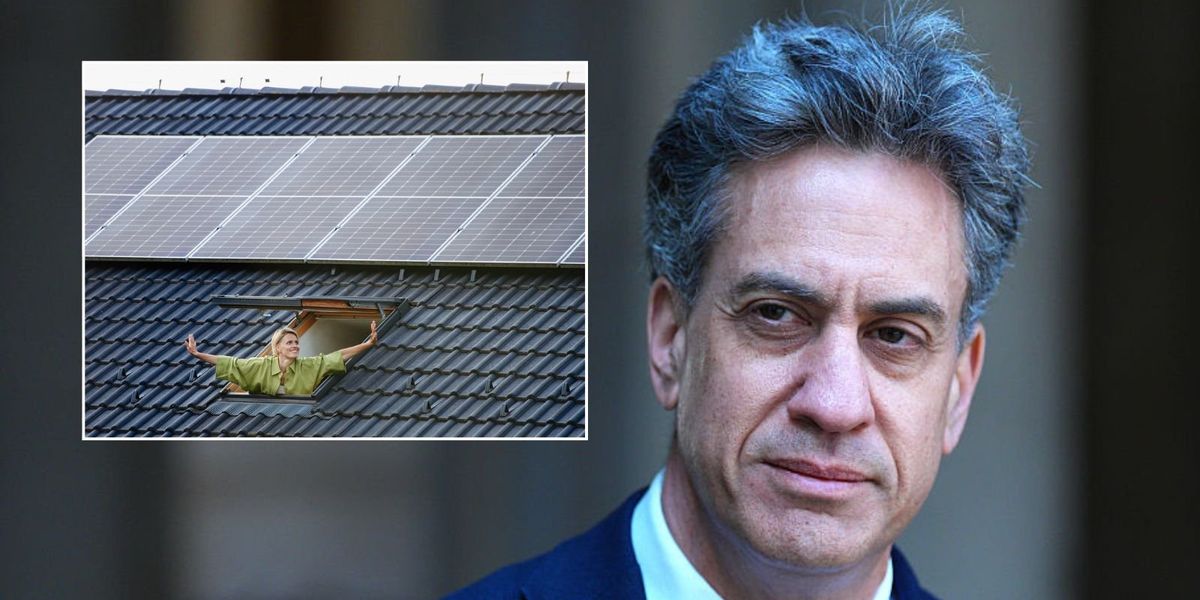
Ed Miliband’s ambitious scheme to make plug-in solar panels available in supermarkets such as Lidl by this summer appears to be running behind schedule.
The discount retailer confirmed this week that it remains in the “early stages” of examining whether to stock the devices, with no firm launch dates yet established.
Back in March, Labour pledged that these affordable solar units would reach shop shelves across Britain “within months.”
The Department for Energy Security and Net Zero indicated it was collaborating with retailers including Lidl and Iceland, alongside manufacturers like EcoFlow, to deliver on this promise.
Government estimates suggest households could reduce annual energy bills by £70 to £110 through plug-in solar installation.
However, a senior engineer at the Institute for Engineering and Technology has cautioned that substantial obstacles remain before these products can safely reach consumers.
Joe Cannon told This is Money: “A great deal of work still needs to happen to make it a reality, safely.”
He observed that while the Government was “pushing hard” to accelerate the rollout, “Enthusiasm and safety don’t always move at the same speed.”
A fundamental problem is the absence of appropriate regulations. “Before these devices go on general sale, we need a dedicated UK product standard for plug-in solar, and one doesn’t currently exist,” Mr Cannon explained.
He warned that products could potentially arrive on shelves before adequate safety frameworks are established.
Ed Miliband’s ambitious scheme appears to be running behind schedule
|
GETTY
The technical difficulties stem from Britain’s distinctive electrical infrastructure, which differs markedly from continental Europe where approximately half a million plug-in solar devices are installed annually in Germany alone.
Unlike conventional household appliances where electricity travels in a single direction, solar panels push power back through domestic circuits.
Most homes contain Residual Current Devices within their fuse boxes, which serve as critical safety mechanisms that cut power during faults.
“It is what stands between you and a serious electric shock,” Mr Cannon noted.
Solar panels push power back through domestic circuits.
|
GETTY
The issue is that many RCDs were engineered for one-directional current flow and may fail to trip correctly when solar panels feed electricity backwards.
Furthermore, the standard British plug explicitly prohibits connection of electrical generators to sockets.
Properties built before the 1980s, including older terraced houses and former council homes, present particular concerns.
Their wiring and consumer units were never intended to cope with modern electrical demands, much less devices generating power back into the system.
Lidl is set to introduce small plug-in solar kits designed for balconies offering an entry-level way to generate electricity without a rooftop installation
|
GETTYResearch from the IET revealed that roughly 70 per cent of households have gone more than a decade without a professional electrical safety inspection.
Cannon highlighted a troubling paradox: “The households most attracted to plug-in solar as a way of cutting costs are often those in lower-income areas, living in older properties with ageing electrical installations.
“They could be the most motivated buyers, and also the most exposed to risk.”
He urged prospective purchasers to arrange an electrical inspection by a qualified professional before buying any plug-in solar device.