
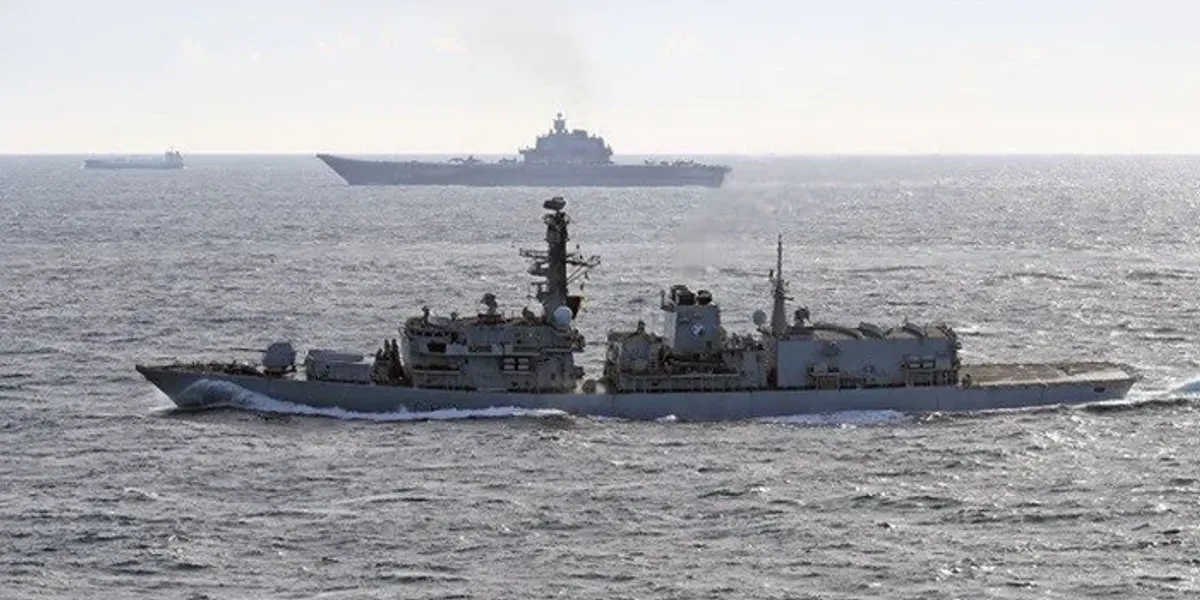
Almost 100 Russian ships have sailed through British waters despite Sir Keir Starmer’s decision to let the military board vessels in the so-called shadow fleet.
In the month after the threat made on March 25, at least 98 Russian vessels subject to British sanctions transited its waters.
There has been no announcement of any boarding or detention of the ships, which typically have an opaque ownership structure and can transport oil, grains and arms, often in support of Russia’s war in Ukraine.
LSEG tracking data shows that 63 ships passed within 12 nautical miles of the coastline in the English Channel, the most direct route between the Baltic Sea and southern Europe.
Another 35 travelled through Britain’s Exclusive Economic Zone, which extends up to 200 nautical miles from the coast, mainly around north Scotland.
Elisabeth Braw, a maritime security expert at the Washington‑based Atlantic Council, said: “You have to quickly follow up with boardings or otherwise those vessels will conclude that it was an empty threat and that is the regrettable situation we are in now.”
Other European countries – including France, Belgium and Sweden – have in recent months boarded and detained Russian shadow fleet vessels.
GB News has contacted the Ministry of Defence for a comment.
The Russian shadow fleet sailed through British waters
|
REUTERS
The Labour Government is coming under pressure from allies to support operations in eastern Europe, the Arctic and the Middle East, despite the British navy being the smallest it has been since the 17th century.
There are currently 544 vessels linked to Russia’s shadow fleet on the British sanctions list.
The data suggested that at least 10 ships passing through had engaged in “spoofing”, turning off or manipulating their tracking systems, when crossing British waters.
The Kremlin claimed sanctions against its ships are illegal and called Britain’s latest policy a “deeply hostile move” that could draw retaliation.
The Kremlin has said sanctions against the ships are illegal
|
GETTYLord Dannatt, the former chief of the general staff, compared the current levels of defence expenditure to the situation before the Second World War.
He said: “In 1939, when war broke out, the figure shot up to 19 per cent and in 1940 when we were fighting for our very survival it rose to the staggering figure of 46 per cent.
“That is the frightening cost of fighting a war that for a modest increase in defence spending earlier could have been avoided.
“Putin is not just a threat but a proven aggressor. Today, where is the prudent Chamberlain who began the rearmament programme or the Churchill who led the country in its darkest hour? No-one of that calibre is at present resident in Downing Street.”
Moscow uses the secret network of ships to dodge Western sanctions on Russian oil exports | GETTY
Former Conservative Prime Minister Sir John Major also said: “We are living in a belligerent environment, which may worsen. The UK, and Europe more generally, must be sufficiently equipped and able to defend itself.
“The argument that ‘we cannot afford it’ will be irrelevant if Putin succeeds in Ukraine — and then, perhaps, moves on into Nato territory.
“If we and our European allies are not prepared to make the necessary sacrifices to protect our people and our sovereign territory, it will be a betrayal of our history and our future.”