
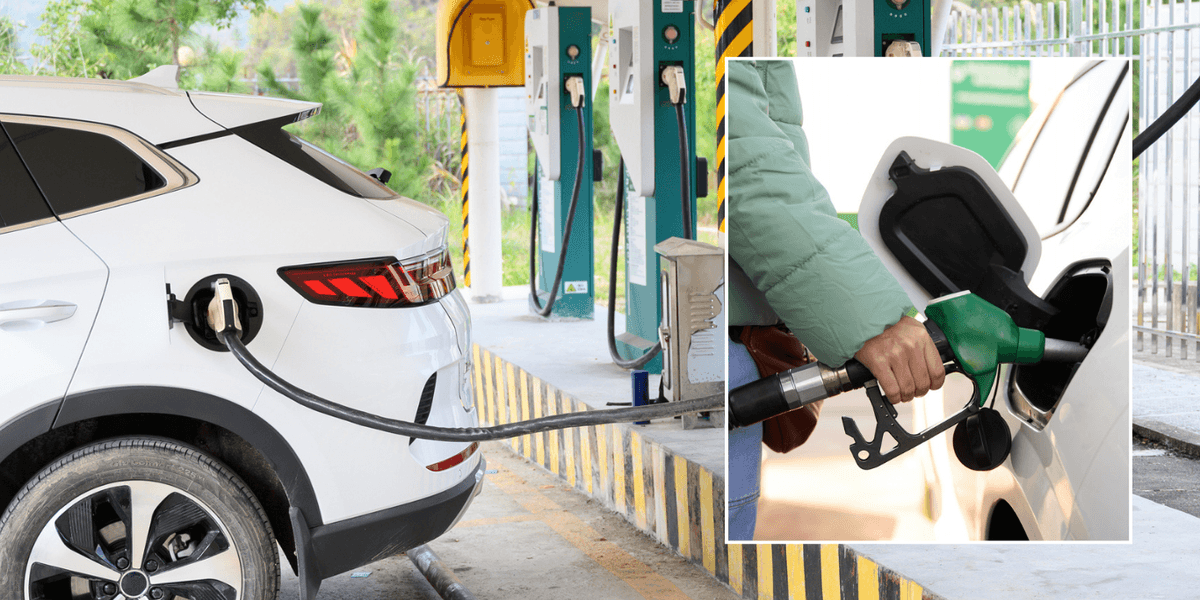
Labour’s flagship electric car plans, which would see petrol and diesel cars phased out by 2030, have faced mounting pressure after new data suggested the transition to EVs will be slower than previously expected.
Updated modelling from the Department for Transport showed while electric vehicles are still set to dominate in the long term, their uptake over the next decade is expected to fall short of earlier predictions.
Electric cars are now expected to account for 29.6 per cent of total vehicle kilometres by 2030, while Light Goods Vehicles are expected to reach around 21 per cent.
The department said the changes reflect updated evidence and policy assumptions, stating the revisions are based on “new historic data” and “updated modelling for the Zero Emission Vehicle mandate”.
The revision means electric driving is now expected to be roughly four percentage points lower for cars and just over four percentage points lower for vans in 2030 compared with previous forecasts.
Officials explained the change has been largely driven by updated rules on how carmakers can meet emissions targets and new evidence on how plug-in hybrid vehicles are actually used in real life.
Changes to the Vehicle Emissions Trading Schemes Order 2023 have given manufacturers more flexibility in how they comply with the UK’s ZEV mandate.
These changes allow companies to borrow credits from future years, trade allowances between firms and use surplus emissions credits to meet their obligations.
The updated predictions follow a heavier reliance by manufacturers on hybrid vehicles
|
GETTYAs a result, manufacturers are now expected to rely more heavily on plug-in hybrid vehicles in the short term. The ZEV mandate still requires 80 per cent of new car sales and 70 per cent of new van sales to be zero emission by 2030, but the way firms meet those targets has become more flexible.
This increased use of hybrids affects overall electric mileage because plug-in hybrids do not drive as much of their distance in electric mode as previously assumed.
The department said “PHEVs complete a smaller proportion of their journeys in electric mode than previously assumed”, meaning less of their total mileage is now counted as electric driving.
This has led to a reduction in expected electric vehicle kilometres, particularly in the early years of the forecast period. The updated modelling described the overall effect as a short-term reduction in electric driving, rather than a long-term shift away from electrification.
Despite the downgrade in the near term, the gap between the old and new forecasts is expected to narrow over time. By 2050, the difference between projections is expected to fall to less than two percentage points for both cars and vans.
The department has updated its forecast for Light Goods Vehicles electric usage
|
PAThe department also stressed that the overall impact on petrol and diesel use remains limited. It states that “the resulting increase in petrol and diesel vkm is small in scale and does not significantly alter long-term trends”.
In other words, while fossil fuel use is slightly higher in the short term, the long-term direction of travel remains largely unchanged.
But the DfT did state that the forecasts remain consistent with the Government’s wider energy and emissions planning assumptions, which include existing policies such as the ZEV mandate.
Alongside changes in vehicle usage, the update also revises expectations for fuel efficiency across different types of vehicles.
The ZEV mandate requires all new petrol and diesel car sales to be electric by 2030 | PA
Petrol cars are now expected to become slightly more efficient over time, although the improvement is described as modest. Diesel cars, however, are expected to become less efficient as newer models tend to be larger and heavier than older ones.
The department noted this trend becomes more pronounced from the 2040s onwards, as less efficient diesel vehicles make up a greater share of the remaining fleet.
For Light Goods Vehicles, changes are relatively small. Petrol vans are expected to improve in efficiency more slowly than previously forecast, while diesel van efficiency remains broadly unchanged.
Overall, the updated figures suggest a slower early transition to electric driving, driven by both policy flexibility and real-world usage patterns.