
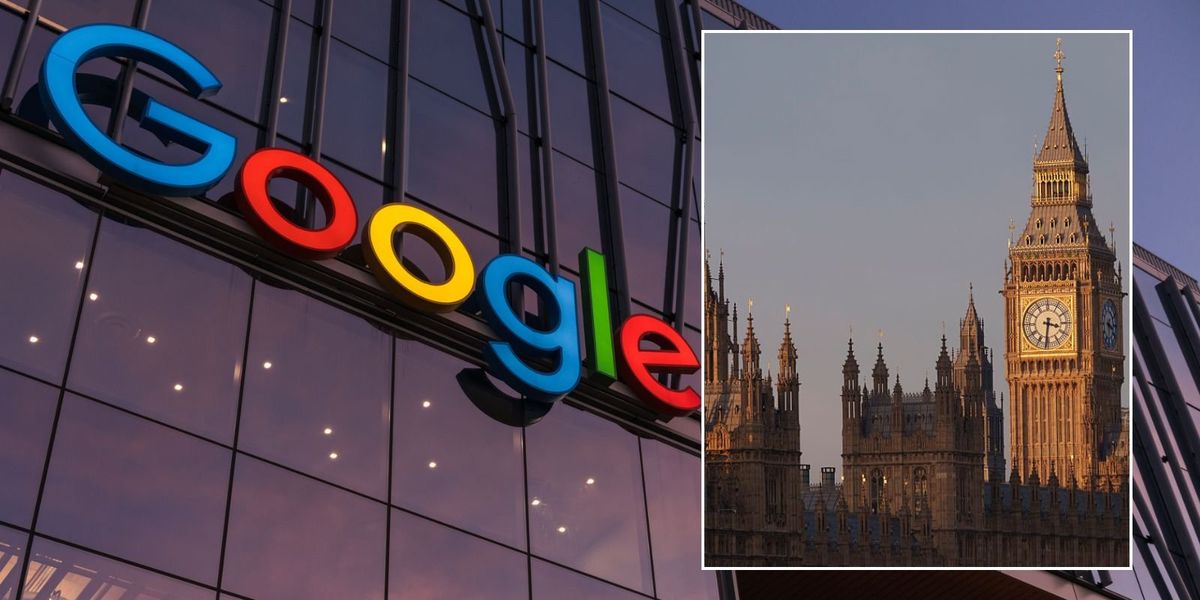
Alphabet, the parent company of Google, is set to join an exclusive club of institutions by issuing a century-long bond denominated in sterling.
The tech giant intends to use this 100-year debt instrument as part of a broader fundraising initiative exceeding $20billion (£15billion) across multiple currencies.
This substantial capital raise aims to support Google’s ambitious $185billion investment programme in artificial intelligence (AI) infrastructure.
The sterling bond will mark Alphabet’s first foray into borrowing in British currency, alongside a debut Swiss franc issuance and several dollar-denominated tranches designed to attract a diverse pool of international investors.
Google has issued a 100-year bond in sterling, signaling confidence in the UK as a place for capital
|
GETTY
The sterling century bond market remains exclusive, with only three organisations having previously issued such debt: the University of Oxford, the Wellcome Trust, and French-backed energy company EDF.
What distinguishes Alphabet’s offering is the fact that the company was founded merely 28 years ago, it stands in stark contrast to its predecessors in this rarefied space.
Oxford had been in existence for eight centuries when it issued its 100-year bond in 2017, while the Wellcome Trust’s equivalent issuance in 2018 came more than 80 years after the charitable foundation was established.
Sovereign nations including Austria, Mexico and Argentina have issued century bonds in other currencies.
Chancellor Rachel Reeves has toured investment in the UK from tech companies
|
GB NEWSDespite recent turbulence in technology stocks driven by fears that AI-linked companies may be overvalued, investor appetite for Alphabet’s debt proved extraordinary.
The bond attracted approximately $100billion in demand, making it five times oversubscribed, Bloomberg reported. Stock markets had fallen sharply the previous week amid growing concerns about inflated valuations in the artificial intelligence sector.
However, confidence appeared to recover on Monday, with the Nasdaq index, which is widely viewed as a gauge of sentiment towards technology firms, climbing one per cent on Wall Street.
The issuance represents the first century bond from a technology company since before the dotcom crash, when IBM and Motorola both issued similar debt in the 1990s.
Alphabet’s decision to borrow over such an extended timeframe serves as a test of investor confidence in artificial intelligence as a transformative technology.
Notably, the company disclosed last week that it would double its capital expenditure to $185billion this year to meet surging demand for AI computing resources.
Systems like ChatGPT and Google’s Gemini require enormous processing power, fuelling an investment race among major cloud providers including Amazon, Microsoft and Oracle.
Collectively, Google, Meta and Amazon have announced plans to spend roughly $660billion this year, which is a 60 per cent increase on the previous year. Alphabet reported $127billion in cash reserves following a 32 per cent rise in annual profits.
The ‘Magnificent 7 stocks’ —Apple, Microsoft, Amazon, Alphabet, Meta, Nvidia, and Tesla— are the primary drivers of the Nasdaq’s value | GETTY
Danni Hewson, AJ Bell’s head of financial analysis at AJ Bell, said: “It’s been a steady start to the week for markets still wrestling with the AI quandary. Which companies will thrive, and which might struggle to stay relevant as this tech revolution picks up speed.
“A lot of focus has rightly been placed on fears of job cuts as businesses battle with continued cost pressures and find they can marry productivity gains with efficiency savings thanks to the ever-evolving world of AI options.
“But investors are now trying to suss out where they might find new AI opportunities as the incredible sums being spent by those tech titans continue to cause jitters.
“London markets seemed to have fallen back on defensive plays, with miners and defence stocks in favour, while lenders likely to be impacted by the ongoing car finance scandal fell as investors mulled over the extra cash set aside by Santander last week.”