
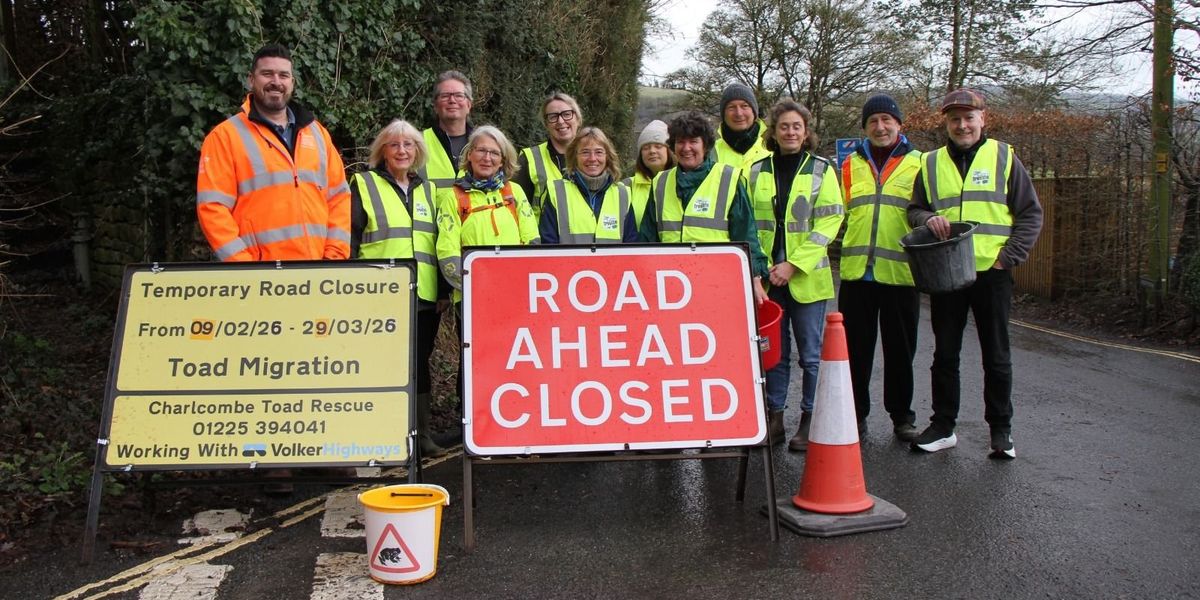
A road in Somerset will close for six weeks to allow thousands of toads, frogs and newts to make their annual journey to breeding grounds.
Charlcombe Lane, near Bath, will shut from February 9 until March 29 as volunteers from the Charlcombe Toad Rescue Group patrol the route each evening at dusk.
Wearing high-vis jackets and armed with torches and buckets, they will spend more than 600 hours helping an estimated 3,000 amphibians cross safely to their ancestral lake in the valley below.
The annual closure, in place each spring since 2003 with the agreement of Bath and North East Somerset Council, is one of only four such road shutdowns in the UK.
The council’s measures have played a crucial role in stabilising the local amphibian population.
Before the scheme began, the casualty rate for the toads reached 62 per cent.
By 2025, it had fallen to just 3 per cent.
Last year was the second-best on record for amphibian numbers, and for the first time, a rare great crested newt was spotted.
A road has been closed for 6 weeks to accommodate the migration of toads
|
FACEBOOK: TOAD RESCUE CHARLCOMBE BATH
Two of the three busiest years for the patrol have been 2024 and last year, although the peak remains 2010.
In 2025, more than 50 volunteers helped 3,995 amphibians along a half-mile stretch of road, bringing the total assisted over 23 years to more than 50,000.
Helen Hobbs, who has managed the group since 2003, said: “Closing Charlcombe Lane, with the support of the local community, has been a game-changer.
“It has meant that our population of toads, frogs and newts have been able to buck national trends and stand a fighting chance of flourishing.”
Volunteers will aid some 3,000 amphibians cross safely to their ancestral lake to breed
|
PA
Ms Hobbs added that climate change has made peak migration harder to predict, making the six-week closure essential.
Research published last year found the UK’s common toad population has fallen by 41 per cent in four decades.
Threats to wildlife included road traffic, habitat loss, intensive farming and milder winters disrupting hibernation.
Across Britain, more than 200 patrols now operate during migration season, carefully carrying amphibians in latex-free gloves and buckets to safety.
‘It has meant that our population of toads, frogs and newts have been able to buck national trends’
|
PA
It comes as efforts to promote Britain’s ancient natural wildlife have gained ground across the country. Last week, Natural England approved two new licences allowing wild beavers to be released at sites across south-west England.
The animals will be introduced at the National Trust’s Holnicote Estate on Exmoor and at a Cornwall Wildlife Trust site in the centre of the county.
The approvals mark only the second and third occasions that beavers have been licensed for wild release since the Government took the landmark decision to allow their return to English rivers.
Beavers are known for dramatically reshaping landscapes by building dams, ponds and channels, creating habitats for other species while also helping to reduce flooding and mitigate drought.
The species was wiped out in Britain more than 400 years ago after being hunted for fur, meat and scent glands.