



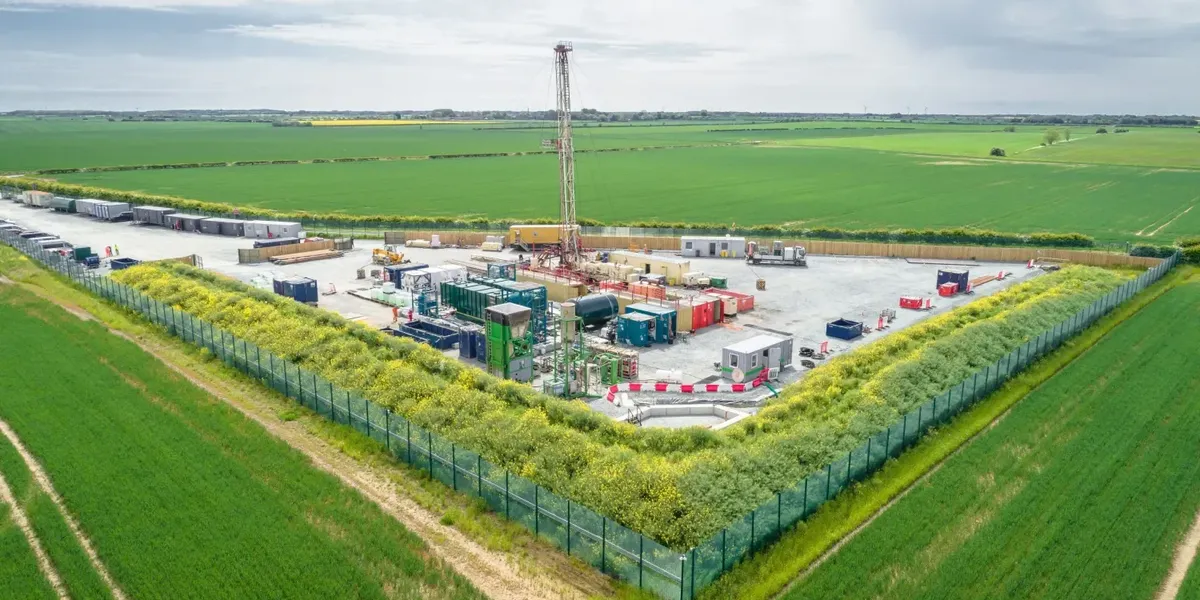
A Yorkshire gas field capable of supplying one tenth of the UK’s power with potential to stabilise Britain’s drastically turbulent energy network will instead be used to mine Bitcoin.
The Environment Agency has granted Reabold Resources permission to conduct low-pressure fracking operations at the West Newton site, located just north of Hull.
This gas field represents one of Britain’s most significant onshore discoveries, with reserves estimated at approximately eight billion cubic metres.
Such quantities could supply more than ten per cent of the nation’s annual gas requirements, offering substantial potential for strengthening domestic energy security.
The drilling location sits within close proximity to National Gas’s transmission infrastructure, making connection to the national grid a straightforward possibility.
Initial exploration of the site dates back to the 1940s, when wartime authorities sought domestic fuel sources. Now Reabold’s leadership team has identified the field’s true scale after revisiting geological data from that era.
Rather than channelling this vast resource into Britain’s energy network, the company intends to construct a small gas-fired power station on site dedicated to cryptocurrency mining.
“A private gas supply means we can run a data centre to mine Bitcoin relatively cheaply,” said Sachin Oza, co-chief executive of Reabold Resources.
The Environment Agency has granted Reabold Resources permission to conduct fracking operations at the West Newton site
|
RATHLIN ENERGY
“Initially, this would help fund the further development of the gas field and prove the concept, meaning it could become the precursor to a far larger data centre.”
The energy demands of Bitcoin production are staggering: generating a single Bitcoin requires burning roughly 150,000 cubic metres of gas, equivalent to filling 50 Olympic swimming pools.
With West Newton’s reserves, the operation could theoretically produce 50,000 Bitcoins, making it an extraordinarily lucrative venture for the company.
Despite this, the decision has provoked fury among environmental campaigners and raised awkward questions for ministers amid energy security concerns triggered by the ongoing conflict in Iran.
Lorraine Inglis, who leads an anti-fracking campaign group in southern England, condemned the project in stark terms.
“The West Newton permit exposes everything that is wrong with the UK’s current approach to energy and climate,” she said. “A new onshore gas field in 2026 is fundamentally at odds with our climate commitments.
“Using that gas to power Bitcoin mining is not energy security or any genuine public benefit, but the deliberate burning of fossil fuels for one of the most energy-intensive and socially questionable activities at a time of high bills and missed climate targets.”
Energy Secretary Ed Miliband introduced a prohibition on full-scale fracking last year
|
PAEnergy Secretary Ed Miliband introduced a prohibition on full-scale fracking last year, prompted by seismic tremors caused by operations near Blackpool.
However, current regulations permit the gentler, lower-pressure extraction techniques that Reabold proposes for West Newton.
Stephen Williams, the company’s other co-chief executive, indicated cryptocurrency mining would likely be just the starting point.
“Alternatively, we could also sell the gas to one of the adjacent industrial centres or connect it to the national gas grid,” he said.
The firm’s most probable strategy involves securing all necessary development and planning permissions before offloading the entire project to a larger operator.
Reabold is no stranger to this approach, having previously obtained permits for the Victory field in the North Sea before selling those rights to Shell for £32million.


