



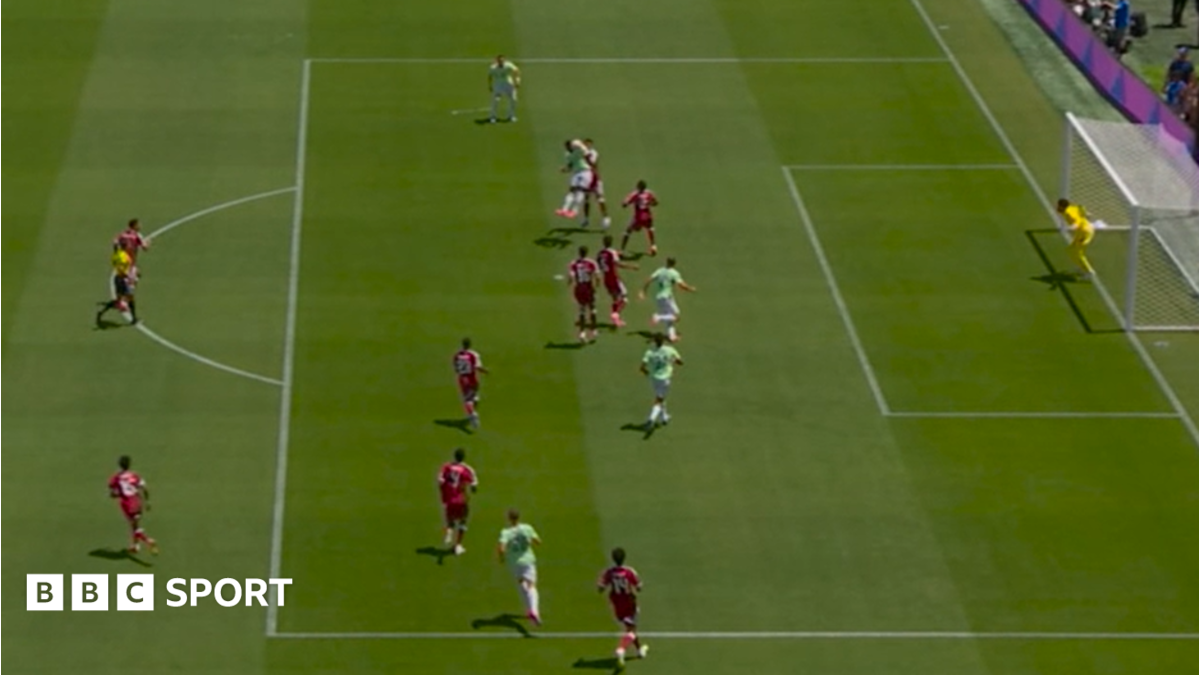
Was Switzerland’s Remo Freuler offside before he was brought down by Qatar goalkeeper Mahmoud Abunada?
It is the question that remains unanswered after a fault with the semi-automated offside system kept everyone guessing.
And it led to a penalty, converted by Breel Embolo, as the teams drew 1-1 in Saturday’s World Cup Group B match in Santa Clara.
Before the tournament, Fifa put a lot of stock in its new, enhanced semi-automated offside system.
World football’s governing body scanned every player at the World Cup to create unique, lifelike avatars of each one.
It was supposed to provide the most accurate illustration of offside decisions we have ever seen.
Yet after a wait of more than four hours for the evidence to prove that Freuler was onside, Fifa released a statement saying “a brief technical outage prevented the onside animation graphic from being generated”.
It went on to say the lines drawn by the video assistant referee (VAR) showed no offside and released two images – which remain unconvincing – but not the usual avatar images.
The statement said: “The workflow of the VAR was not affected by this issue and followed the normal procedure in checking the on-field decision.
“The lines used by the VAR to check the position of the relevant players did not show the attacking player to be in an offside position in either of the two situations immediately before the penalty decision.”
“We all think it here [that it was offside],” Gary Neville said on ITV before the statement was released.
“Everybody at home thinks it. Fifa are the host broadcaster and they have the semi-automatic decision that they can show us.
“There is a massive question over that because it is offside in my eyes until they prove to me different.”
If there is one thing that is guaranteed to create doubt it is delay. It creates a vacuum that feeds conspiracy theories. It might give the impression Fifa is hiding something.


