



When the India-UK CETA was signed on 24 July 2025 after 14 rounds of negotiations, the mood in Westminster was one of quiet celebration. A year later, with the agreement now in effect, the question has shifted from “will it happen?” to “what happens next?”
For British SMEs, the agreement opens a market of 1.4 billion people and a rapidly expanding middle class. India’s economy is projected to grow at over 6% annually, making it one of the world’s fastest-growing major economies. But tariff elimination alone does not guarantee market access.
What the deal actually does
Under the CETA, the UK will eliminate tariffs on 99% of Indian exports, while India will reduce tariffs on 90% of UK exports, with most liberalisation occurring within five to seven years. For UK businesses, this means Scotch whisky, gin, chocolates, biscuits and cosmetics will see tariffs begin declining from day one. Indian exports including textiles, leather, gems and jewellery, engineering goods, marine products and processed foods will enter the UK duty-free.
The agreement comprises 30 chapters covering trade in goods and services, digital trade, financial services, intellectual property, innovation, sustainability and government procurement. It also includes provisions for mutual recognition of professional qualifications and enhanced professional mobility.
The readiness gap
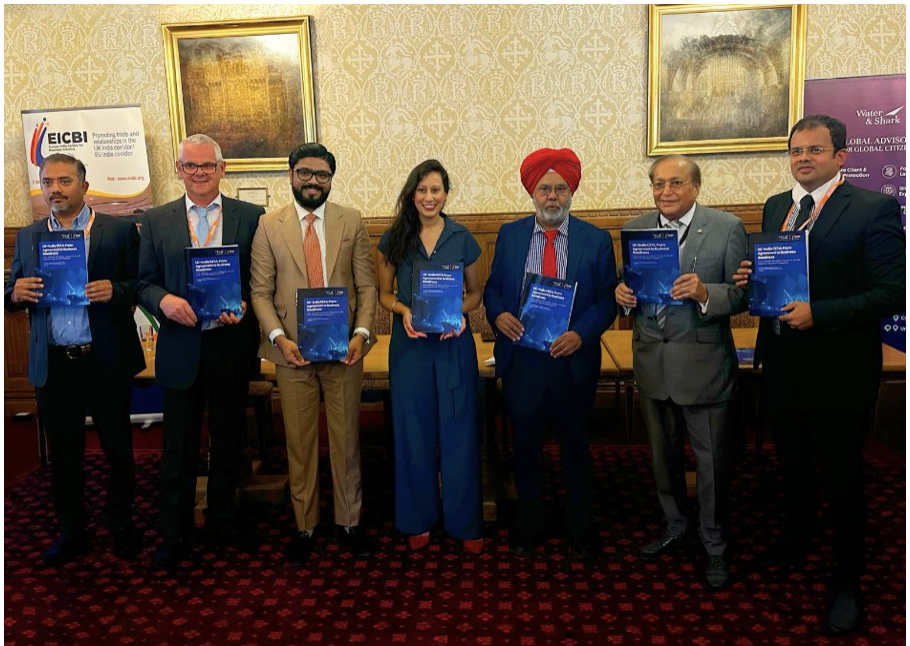
Yet industry observers have noted a significant gap between the agreement’s potential and business preparedness. A strategic intelligence report titled “UK–India CETA: From Agreement to Business Readiness,” prepared by Water & Shark in association with the Europe India Centre for Business and Industry (EICBI), was launched at the UK Parliament on 13 July 2026 to address precisely this gap.
The report, unveiled during the UK India Leaders Conference, was attended by Members of the UK Parliament of Indian origin, including Sonia Kumar MP, Lord Rami Ranger and Lord Kuldip Sahota, alongside Baroness Pola Uddin and Navendu Mishra MP. It examined how the CETA could unlock opportunities across trade, investment, innovation, services, supply chains and professional mobility.
The central argument of the report is that FTAs succeed or fail based on how well businesses are prepared to use them. A framework outlined in the report emphasises what it calls the “Three Cs” – Confidence, Capability and Consistency – as essential pillars for businesses seeking to navigate the new trade landscape.
What UK SMEs should do now
For British SMEs, the immediate priority is understanding the specific opportunities in their sector. The agreement provides enhanced market access in financial services, digital trade and manufacturing. Processed food products will enjoy duty-free entry on 97.1% of tariff lines, while eligible Indian vehicles exported within an annual quota will enter the UK duty-free, giving them a 10-percentage-point tariff advantage.
Commerce Secretary Rajesh Agrawal has said the government’s focus will now be on ensuring exporters fully utilise the preferential market access available under the agreement. A practical business utilisation manual, developed jointly by the UK India Business Council and HSBC India, was launched in June 2026 to help companies maximise trade opportunities.
Industry representatives have called for greater awareness of the agreement, particularly among micro, small and medium enterprises, simpler regulatory procedures and certification requirements, and stronger industry-to-industry partnerships.
The bigger picture
Beyond the numbers, the agreement represents a significant shift in the UK’s post-Brexit trade strategy. India is now one of the UK’s most important trading partners outside Europe, and the CETA is expected to boost bilateral trade, which has the potential to nearly double to around USD 120 billion by 2030.
For UK SMEs, the message from the parliamentary launch is clear: the agreement is now in force. The window of opportunity is open. The question is no longer whether the deal will happen, but whether British businesses are ready to act.


