

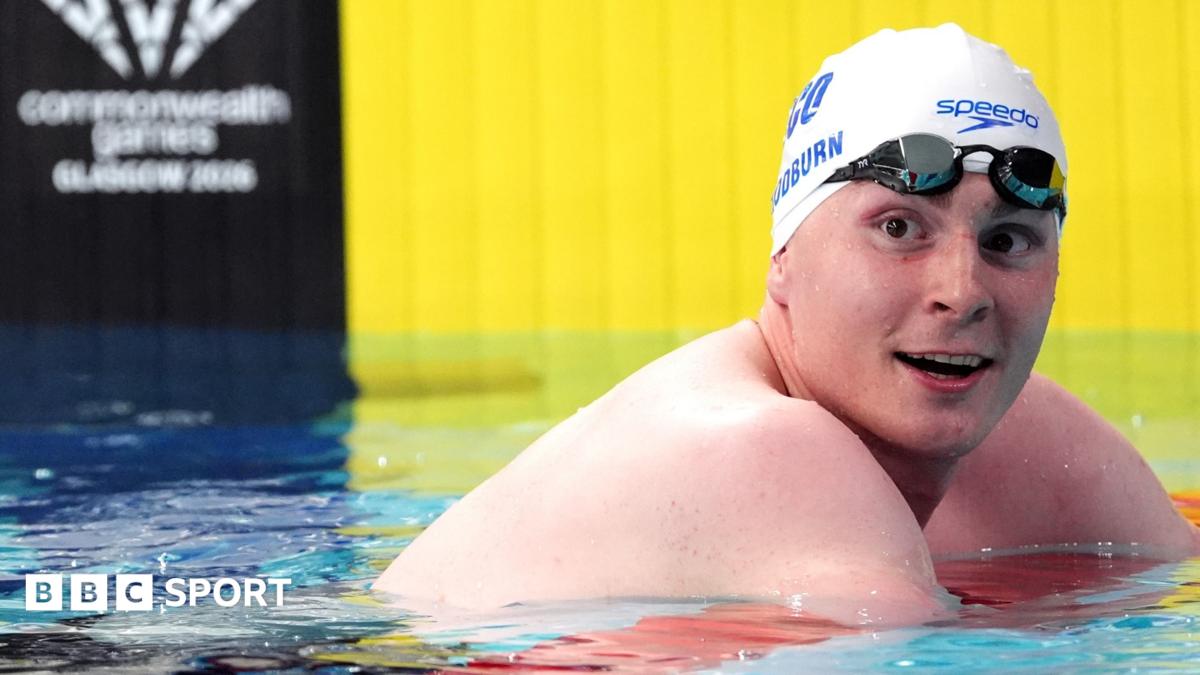
The attitude is understandable. Goodburn is – astonishingly – is in the best shape of his life in swimming terms. He lowered the national record to 27.12 seconds in February and qualified fifth fastest for this.
New treatments – which he fought hard to be given access to – have slowed the growth of his tumours, and he recently graduated from Edinburgh University with a first in chemical engineering.
Ultimately, he finished joint seventh – “joint last” as he put it – and missed out on the 50m breaststroke medal he craved.
But this race and this week has been about so much more than podiums and plaudits for this remarkable young man from Edinburgh, who continues to fight not only his own brain cancer, but the impact of the disease on others.
“It’s pretty indescribable,” he told BBC Sport Scotland when asked what the past 24 hours have been like. “Usually the words flow easily, but I’m finding myself quite speechless.
“I was really trying to soak it up, because I didn’t feel like I really got much of a chance to do that after the semi. And the experience was everything I dreamed of and more. But the time, unfortunately, wasn’t there.”
These Games – and this summer – have been such a focus for Goodburn amid the darkness of the past two years, and he spoke afterwards about being eager to watch back the race and pour over his data as many athletes would.
He also talked about the support of his family and girlfriend Ciara Schlosshan, who competed for Scotland in the 100m butterfly just five minutes before he did.
But not many swimmers – standing wrapped in a towel, goggles strapped to their head and wearing just their jammers – would talk so passionately and eruditely about ensuring brain cancer research is properly resourced.
Team-mate Duncan Scott called him “inspirational” and no wonder.
“I was thinking today, the goal was to make the final, and the dream was to win a medal,” Goodburn said. “That dream didn’t come true, but one of my other dreams is that we see a future where brain cancer isn’t the biggest killer of patients under 40.
“I advocate to try and extend my own life, but also for the other young patients and adults going through what I’m going through.
“With everything that’s going on with my health, it’s been difficult to think ‘why am I here? Am I here to advocate as a patient advocate, or am I here to just be a professional athlete?’ And it’s kind of turned into a bit of both.
“I wonder how I’m going to feel off the back of this. But I know that I’m going to have memories to last a lifetime.”