



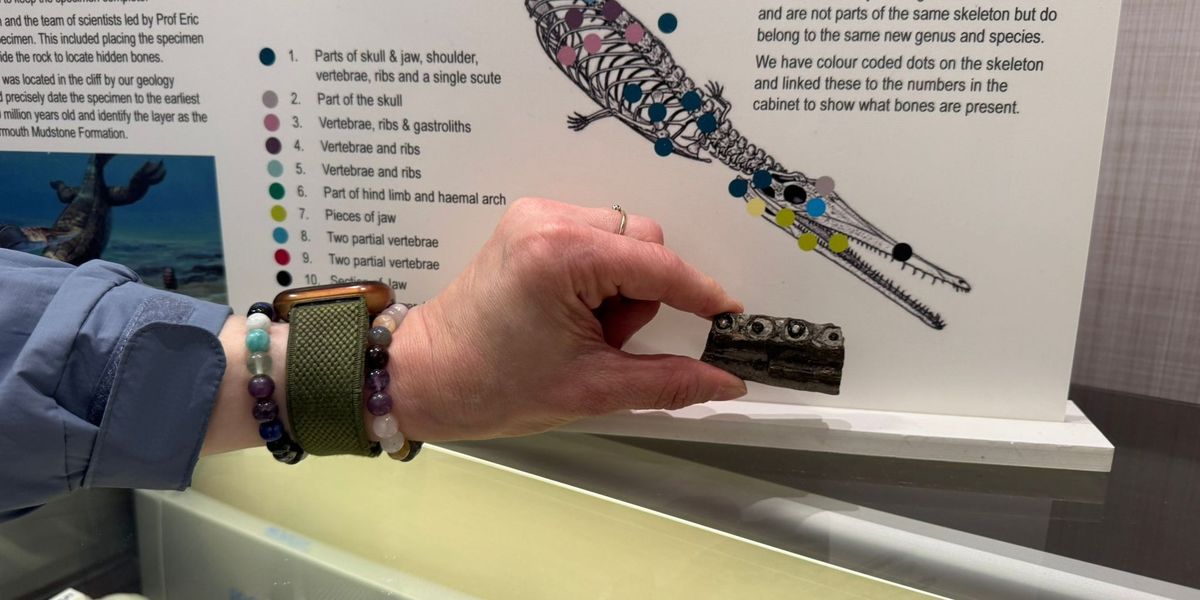
A walker has stumbled upon an extraordinarily rare piece of prehistoric history while searching for fossils along the Dorset coastline.
Heather Salt, an amateur enthusiast who joined a guided expedition at Lyme Regis, made the remarkable discovery of an upper jawbone belonging to the planet’s most ancient known sea-dwelling crocodile.
When she first spotted the specimen, Ms Salt believed she was looking at something far more mundane.
She said: “I looked down and thought it was nails stuck into something”, adding that the beach near an eroding old dump site contains numerous metal fragments.
Upon realising the object was actually stone, her suspicions grew, adding: “I really just wanted to find a little ammonite.”
The fossil represents one of just 11 specimens ever recovered from this particular creature, which roamed the seas approximately 200 million years ago.
Casey Rich, who leads fossil walks for Lyme Regis Museum, recognised immediately that something extraordinary had landed in his hands when Ms Salt presented her find.
His initial assessment suggested it might belong to an ichthyosaur or plesiosaur, both significant marine reptiles from the period.
The fossil was found by walker Heather Salt
|
LYME REGIS MUSEUM
“Bits of ichthyosaur are rare enough, so even if it was a piece of ichthyosaur it would have been a fantastic day,” he said.
However, when a colleague glanced at the specimen and suggested it could be crocodile, the true magnitude of the discovery became apparent.
“When you hear ‘croc’, you instantly think of the rarity,” Mr Rich explained. “How special that find potentially is really started to hit home.”
He added: “I’m just grateful it was on one of my walks.”
Heather Salt said she wanted to ‘find a little ammonite’
|
LYME REGIS MUSEUM
Dr Paul Davis, the museum’s palaeontologist and geology curator, examined the specimen after hearing about the discovery.
“He got so excited and he said, ‘that’s croc!'” Ms Salt recalled.
The find holds considerable scientific value, according to Dr Davis, who explained that it will assist researchers in understanding how these Jurassic predators hunted in primordial seas.
He noted that the specimen belongs to a critical period in evolutionary history when crocodylomorphs were diversifying rapidly, yet fossil evidence remains scarce.
Lyme Regis Museum will be displaying the artefact
|
Dr Davis said. “These are some of those critical fossils. It shows that even 200 million years ago, they were already highly evolved and adapted for a marine habitat.”
The discovery will particularly help scientists comprehend how the creature’s jaws functioned and how it captured fish.
Dr Davis expressed hope that a complete skull might eventually be unearthed, which would resolve outstanding questions about their evolution and biology.
The creature known as the Charmouth Crocodile, first identified in 2017 at the nearby coastal village, spent the majority of its existence in marine environments, venturing onto land solely for egg-laying and rearing offspring.
The discovery was found on the Jurassic coast near Lyme Regis
|
GETTY
Measuring roughly two metres in length, this slender reptile possessed an elongated, narrow snout specifically evolved for consuming fish.
Though commonly referred to as a marine crocodile, the animal is more precisely classified as a thalattosuchian rather than a true crocodilian, with both groups belonging to the broader Crocodylomorpha family that traces its origins back some 230 million years.
Ms Salt chose to donate her find to the museum after learning of its significance.
“I did find my own little ammonite in the end which was what I really wanted,” she said.


